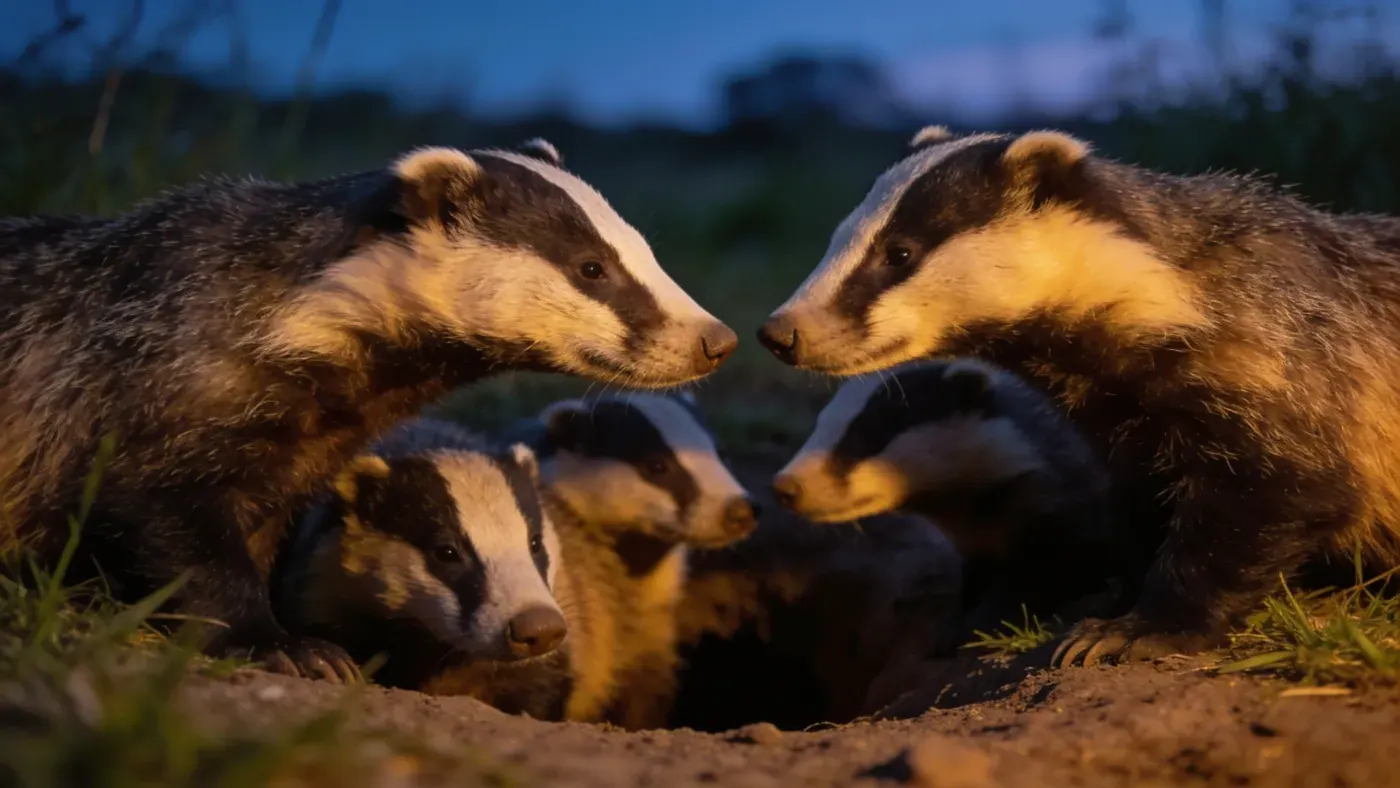
Living in Clans
Unlike many solitary mustelids, Eurasian badgers are unusually social, living in groups called clans that can number anywhere from two or three animals to more than a dozen, sharing a single main sett. Clan size and stability vary considerably by region, generally tracking how much food the local habitat can support — richer feeding grounds tend to sustain larger, more settled groups.
A Loose Hierarchy
Within a clan, a dominant boar and sow typically hold the best access to breeding, though the hierarchy is looser and less rigidly enforced than in many other social carnivores. Badgers forage individually rather than as a coordinated group, so clan life centers less on cooperative hunting and more on shared defense of the sett and territory.
Scent as a Social Glue
Badgers rely heavily on scent to maintain clan bonds and mark territory, rubbing musk from a gland beneath the tail onto other clan members, tree stumps, and boundary markers in a behavior known as "allo-marking." This shared scent lets badgers instantly recognize clan-mates from intruders, and territorial latrines — communal dung pits dug at boundary points — serve as a clear "keep out" signal to rival clans.
Territorial Disputes
Boundary skirmishes between neighboring clans do occur, usually as brief, noisy confrontations involving growling, chasing, and occasional biting rather than sustained fighting. Because setts represent such a heavy long-term investment of digging effort, clans strongly prefer to defend an existing territory over risking injury trying to seize a rival's — most disputes settle without serious harm to either side.