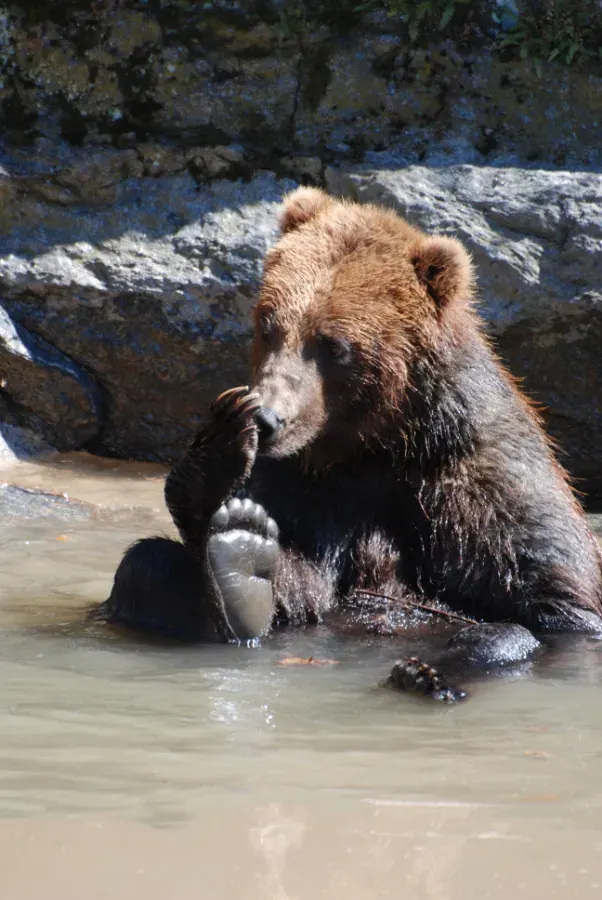
Key figures for Ursus arctos horribilis.
Scientific name
Ursus arctos horribilis — a subspecies of the brown bear, not a separate species.
Weight
Males 300–700 lbs interior; coastal brown bears considerably heavier. Females roughly two-thirds the weight of males.
Height
3–4 ft at the shoulder on all fours; 6–8 ft standing upright.
Identification
Shoulder hump, dished facial profile, and front claws 2–4 inches long. Colour is not a reliable guide.
Speed
Capable of 30 mph over short distances — faster than a human on any terrain, uphill or down.
Diet
Omnivorous: grasses, sedges, roots, berries, insects, rodents, ungulate carrion and salmon where available. Meat is typically a minority of the diet by volume.
Home range
60–500+ square miles depending on food density; males range far more widely than females.
Denning
October/November to March/May. Dens are dug by the bear, usually on north-facing slopes.
Gestation
About 6.5–8 months including delayed implantation; cubs born in the den in January or February.
Litter size
1–3 cubs, about 1 lb each at birth. Cubs stay with the mother 2–3 years.
Sexual maturity
4–6 years. One of the slowest reproductive rates of any North American mammal.
Life span
20–25 years in the wild.
US population
Roughly 2,000 in the lower 48 states, plus around 30,000 in Alaska.