Classification and Origin
The polar bear is Ursus maritimus, a member of the family Ursidae and a close relative of the brown bear — close enough that the two can interbreed and produce fertile offspring. Genetic evidence places the split within the last several hundred thousand years, making the polar bear a geologically recent species and the most rapidly specialised large carnivore in the northern hemisphere.
Size and Appearance
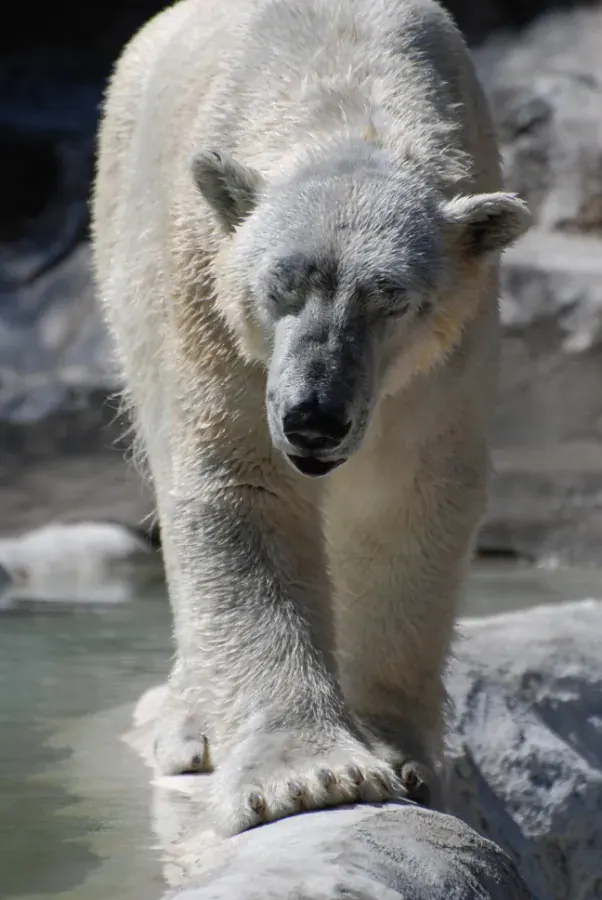
Adult males typically weigh 900 to 1,600 pounds and measure eight to ten feet in length; females are roughly half that weight. Compared with a brown bear, the polar bear has a longer neck, a narrower head and a more elongated body — a shape suited to swimming and to reaching into seal holes. There is no shoulder hump.
Behaviour
Polar bears are solitary and, unlike most bears, do not den seasonally as a matter of course — only pregnant females reliably enter maternity dens. The rest of the population may hunt through the winter darkness. Bears travel enormous distances over the course of a year, following the ice, and are capable swimmers documented crossing dozens of miles of open water.
Reproduction
Mating occurs on the spring ice. Implantation is delayed, and a pregnant female enters a snow den in autumn, giving birth to one or two cubs around midwinter. The cubs weigh about a pound at birth and emerge in spring at roughly 20 to 30 pounds. They stay with their mother for about two and a half years, which limits females to a litter roughly every three years — a slow reproductive rate that makes population recovery difficult.
Conservation Status
The species is listed as Vulnerable on the IUCN Red List. It is protected under national legislation across its range and by the 1973 International Agreement on the Conservation of Polar Bears, which ended unregulated commercial hunting. Habitat loss through sea-ice decline is now the dominant threat, with pollution, shipping traffic and industrial development as secondary pressures.