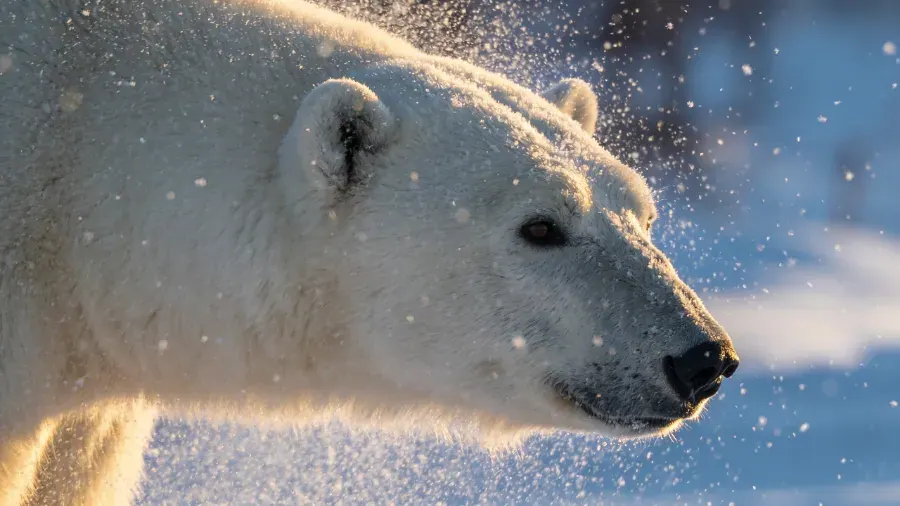
Key figures for Ursus maritimus.
Scientific name
Ursus maritimus — "sea bear". Classified as a marine mammal, the only bear to hold that status.
Weight
Males 900–1,600 lbs; females 330–650 lbs. Weight swings enormously with the seal-hunting season.
Length
8–10 ft for adult males, measured nose to tail.
Insulation
Up to 4 inches of fat beneath a dense undercoat and an outer layer of hollow, transparent guard hairs. The skin beneath is black.
Diet
Chiefly ringed and bearded seals, supplemented by walrus, beluga carcasses, seabird eggs and, on shore, vegetation and carrion.
Range
The circumpolar Arctic across Canada, the USA, Russia, Greenland and Norway — 19 recognised subpopulations.
Population
Roughly 22,000–31,000 animals; about two-thirds are in Canada.
Gestation
Around 8 months including delayed implantation. Cubs are born midwinter in a snow den.
Litter size
Usually 2 cubs, each weighing about 1 lb at birth. Cubs remain with the mother for about 2.5 years.
Swimming
A strong swimmer; individuals have been tracked crossing more than 200 miles of open water.
Life span
20–25 years in the wild.
Status
Vulnerable (IUCN). Sea-ice loss is the primary threat.