From Tens of Millions to Near Zero
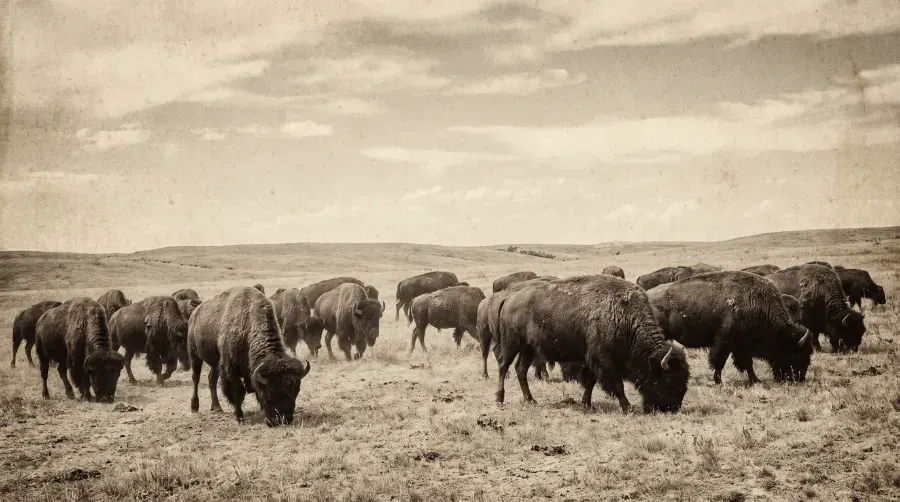
Before European settlement, an estimated 30 to 60 million bison roamed North America, forming herds so large that early travelers described them stretching to the horizon. By 1889, fewer than 1,000 bison remained on the entire continent — a collapse that took place within a single human lifetime.
Commercial Hunting on an Industrial Scale
The arrival of railroads across the Great Plains in the 1860s and 1870s opened bison herds to commercial hunters, who could ship hides east by the trainload. Professional hunters using powerful rifles could kill dozens of bison in a single stand, often taking only the hide and tongue and leaving the rest of the carcass to rot on the prairie.
A Deliberate Military Strategy
Beyond commercial demand, U.S. military and government officials actively encouraged the mass killing of bison as a strategy to force Plains Indigenous nations onto reservations, since bison were central to their food supply, clothing, tools, and culture. Some officers openly stated that destroying the herds was the fastest way to subdue Native resistance.
A Handful of Survivors Made Recovery Possible
By the time hunting slowed in the 1880s, only a few scattered groups survived, including a small wild herd in Yellowstone and several private herds kept by ranchers who had seen the species' collapse coming. These few hundred animals became the genetic foundation for every bison conservation herd that exists today.