Our Closest Living Relative
Chimpanzees share roughly 98.6% of their DNA with humans, more than any other living species, a fact confirmed repeatedly by genetic studies since the 1980s. That closeness shows in shared behaviors — tool use, complex social bonds, and even mourning — that scientists once assumed were exclusively human.
Fission-Fusion Societies
Chimpanzee communities can number over 100 individuals, but members rarely travel together as one group. Instead they split into smaller, fluid subgroups that form and dissolve throughout the day depending on food availability and individual relationships — a social system known as fission-fusion.
Toolmakers in the Wild
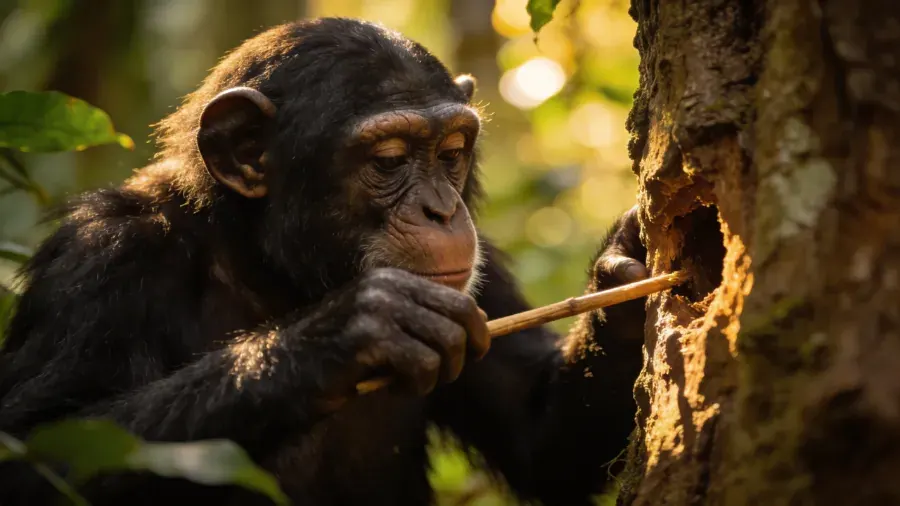
Long before Jane Goodall's landmark 1960 observations at Gombe, chimpanzees had already been fashioning and using tools — stripped twigs for termite-fishing, leaves as sponges, stones as hammers — for generations. Each community maintains its own toolkit traditions, learned socially rather than instinctively.
Expressive and Emotional
Chimpanzees laugh when tickled, comfort distressed group members with embraces, and display grief-like behavior around deceased companions. Facial expressions, pant-hoots and body language combine into a rich communication system that researchers are still working to fully decode.
Endangered by Habitat Loss
Chimpanzee populations have fallen sharply over the past century due to deforestation, poaching and disease, with wild numbers now estimated at fewer than 300,000 across a fraction of their historic range — a decline that continues even in many protected areas.