Seven Bones, Enormously Stretched
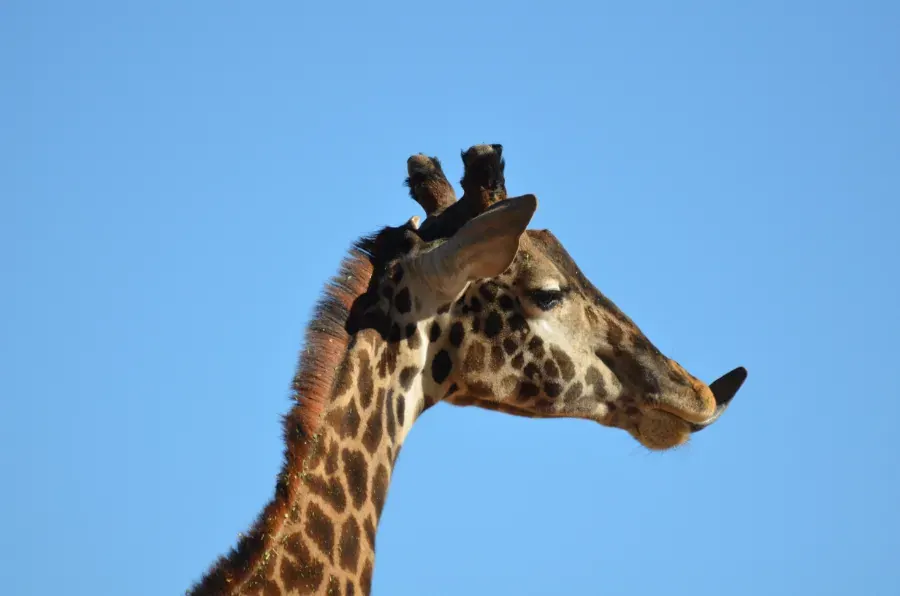
The most surprising fact about the giraffe’s neck is how ordinary its underlying structure is. It holds seven cervical vertebrae — the same count found in almost every mammal, humans included. Each vertebra is simply extended enormously, with some individual bones reaching close to ten inches in length. The neck alone can measure six feet and weigh around 600 pounds, supported by a powerful nuchal ligament running from the shoulders that holds the head up with far less muscular effort than the weight would suggest.
A Circulatory System Built for the Height
Lifting blood six feet above the heart requires extraordinary pressure. A giraffe’s heart is thick-walled and generates blood pressure roughly twice that of a human, and its arteries in the neck are heavily reinforced. The harder problem is the reverse: when a giraffe lowers its head to drink, that same pressure would flood the brain. Two adaptations prevent it — one-way valves in the jugular veins that stop backflow, and a dense network of small vessels at the base of the skull, the rete mirabile, which buffers the surge before it reaches the brain. Tight skin on the legs works like a compression stocking to stop blood pooling in the feet.
Why the Neck Grew: Two Competing Explanations
The classical explanation is feeding competition — a longer neck reaches foliage other browsers cannot, an advantage during dry seasons when low browse is stripped bare. Field observations complicate it: giraffes frequently feed at shoulder height or below, and rarely exploit the tallest trees on the savanna such as baobab or sausage tree. The competing explanation is sexual selection. Bulls fight by "necking," swinging the head like a club, and males have markedly heavier necks and thicker skulls than females — consistent with a structure shaped substantially by male combat. Current thinking treats the two as complementary rather than exclusive: feeding advantage and combat advantage acted together.
A Handicap as Well as an Asset
The neck is not costless. Drinking and lying down both leave a giraffe momentarily vulnerable, and rising again is slow. Feeding on acacia often means bending the neck downward rather than reaching up. The long trachea adds dead air space, which is why giraffes breathe more slowly and deeply than their body size would predict. Evolutionary structures of this kind are usually compromises, not optimal designs.
What the Name Means
The genus name Giraffa derives via Arabic zarafah, and the species name camelopardalis comes from the Greek — literally "camel-leopard," a description early Mediterranean observers reached for when trying to convey an animal with a camel’s stature and a leopard’s markings.