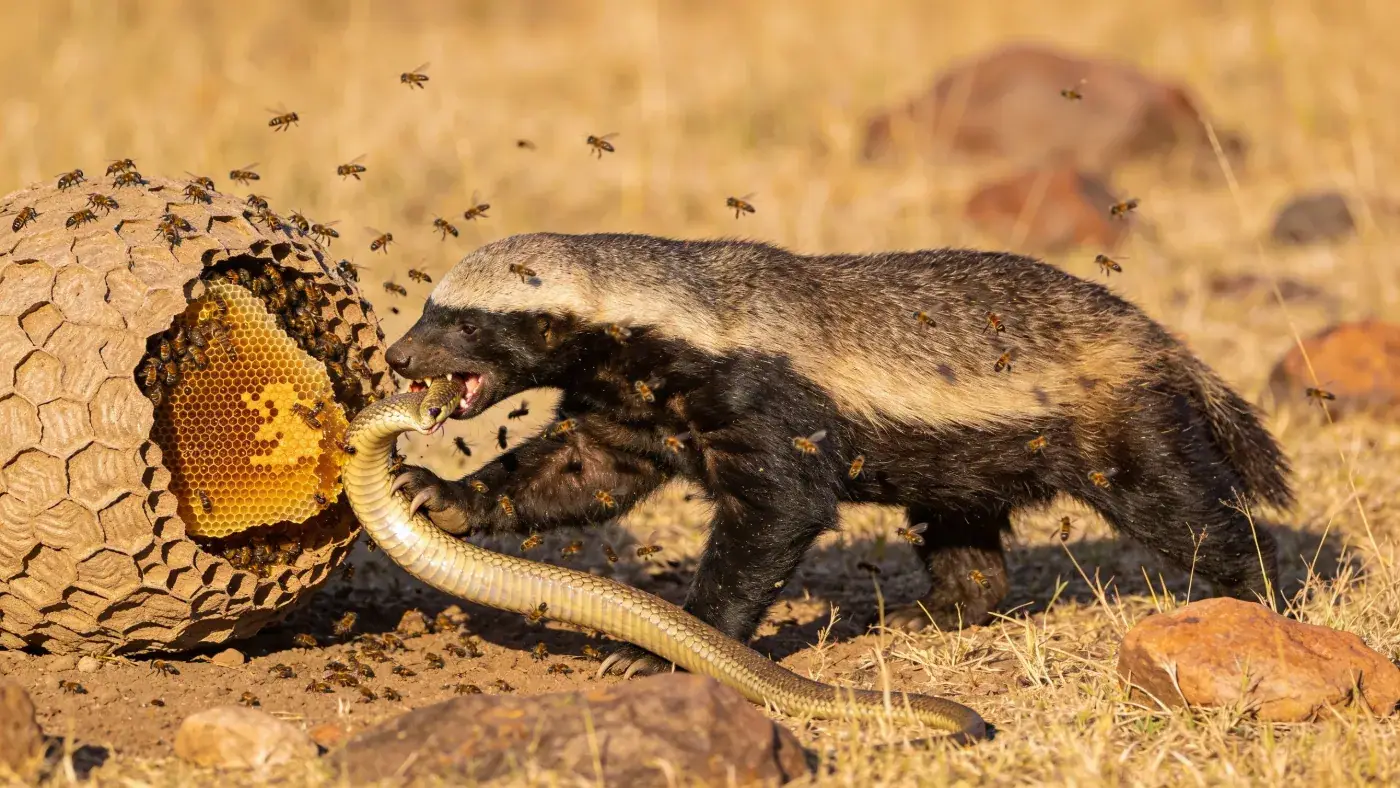
An Opportunistic Omnivore
Honey badgers eat an unusually broad range of food for a mustelid, including rodents, insects, birds and their eggs, fruit, roots, and — famously — venomous snakes. This flexibility lets honey badgers survive in habitats as different as dense rainforest and open desert, adjusting their diet to whatever food is locally most abundant.
Taking on Venomous Snakes
Honey badgers are one of very few mammals that regularly kill and eat venomous snakes, including cobras and puff adders. Research has shown honey badgers have a degree of physiological resistance to certain snake venoms, letting them survive bites that would likely kill a similarly sized mammal without that resistance — though a large enough dose, or a bite in a vulnerable spot, can still prove fatal.
The Origin of the Name
The species gets its common name from its taste for honey and bee larvae, which it accesses by tearing into wild beehives with its powerful claws, largely undeterred by stings thanks to its thick skin. This same trait has made honey badgers a persistent nuisance for beekeepers across parts of Africa, who often have to fortify hives specifically against raiding badgers.
Conflict With Farmers
Beyond bees, honey badgers occasionally prey on domestic poultry and small livestock, putting them into direct conflict with farmers in some regions. This conflict is one of the main drivers of honey badger persecution today, even though the species remains widespread overall and is not currently considered threatened.