An Almost Unbelievably Short Pregnancy
A kangaroo’s gestation lasts only around 31 to 36 days, among the shortest of any mammal relative to adult size. Almost all of a joey’s development happens after birth rather than in the womb — the newborn is barely more than an embryo, blind, hairless, and roughly the size and weight of a jellybean.
The Journey to the Pouch
Immediately after birth, the tiny joey uses only its relatively well-developed forelimbs to crawl, unassisted by the mother, from the birth canal up through her fur to the pouch — a journey of only a few inches that nonetheless takes several minutes of determined effort for an animal that cannot yet see or hear.
Life Inside the Pouch
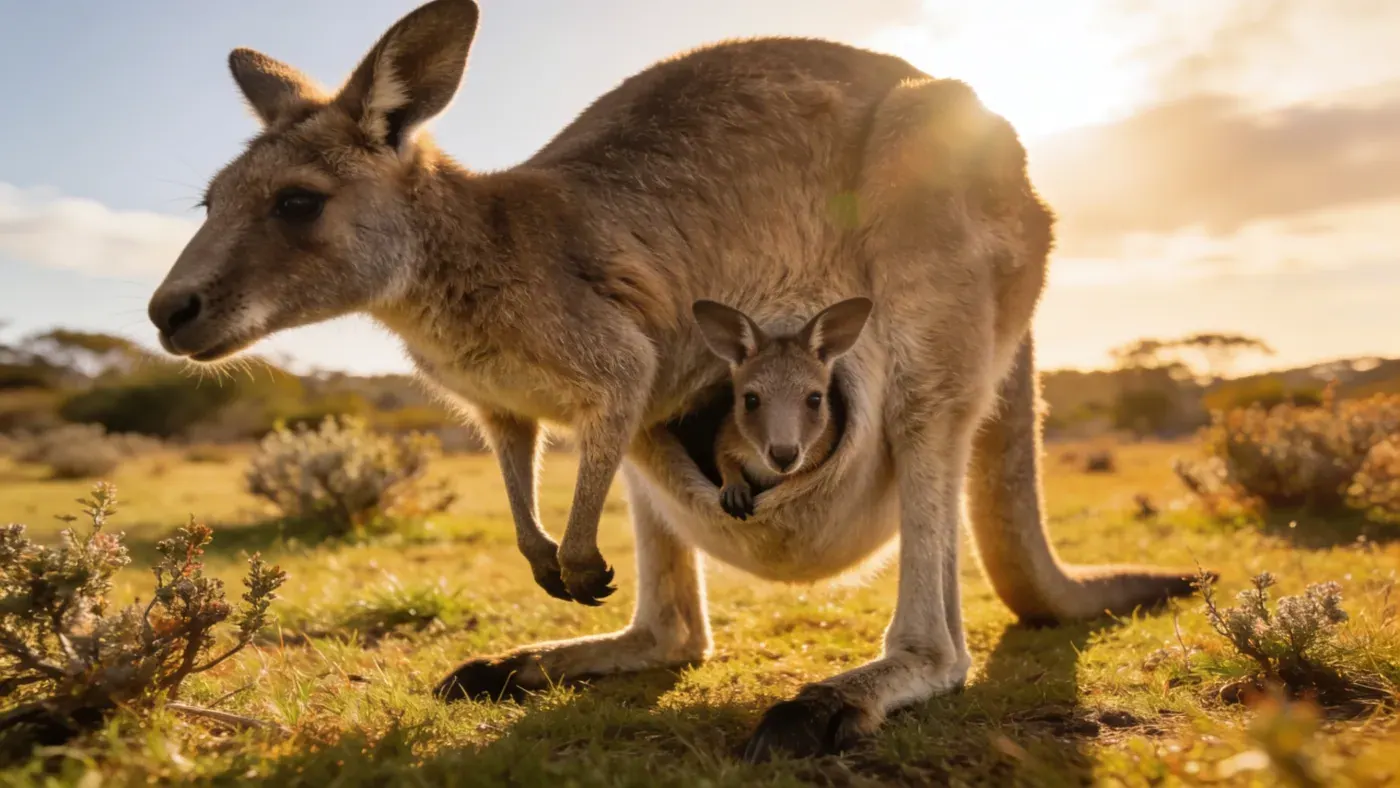
Once inside, the joey attaches firmly to one of four teats, which swells to hold it in place, and remains permanently attached for the first couple of months, receiving milk whose composition changes over time to match its developing needs. It first opens its eyes around three months and starts poking its head out of the pouch around five to six months.
Leaving, Gradually
A joey begins taking short excursions out of the pouch around six to eight months, returning to it for safety, warmth and milk, and is not fully weaned and independent of the pouch until around ten to eleven months, though it may continue nursing outside the pouch for some time after that.
Embryonic Diapause
Female kangaroos have a remarkable reproductive adaptation: they can mate again almost immediately after giving birth, but the resulting embryo pauses its development — a state called embryonic diapause — until the older joey has left the pouch, allowing a female to have three joeys of different ages in different developmental stages at once.