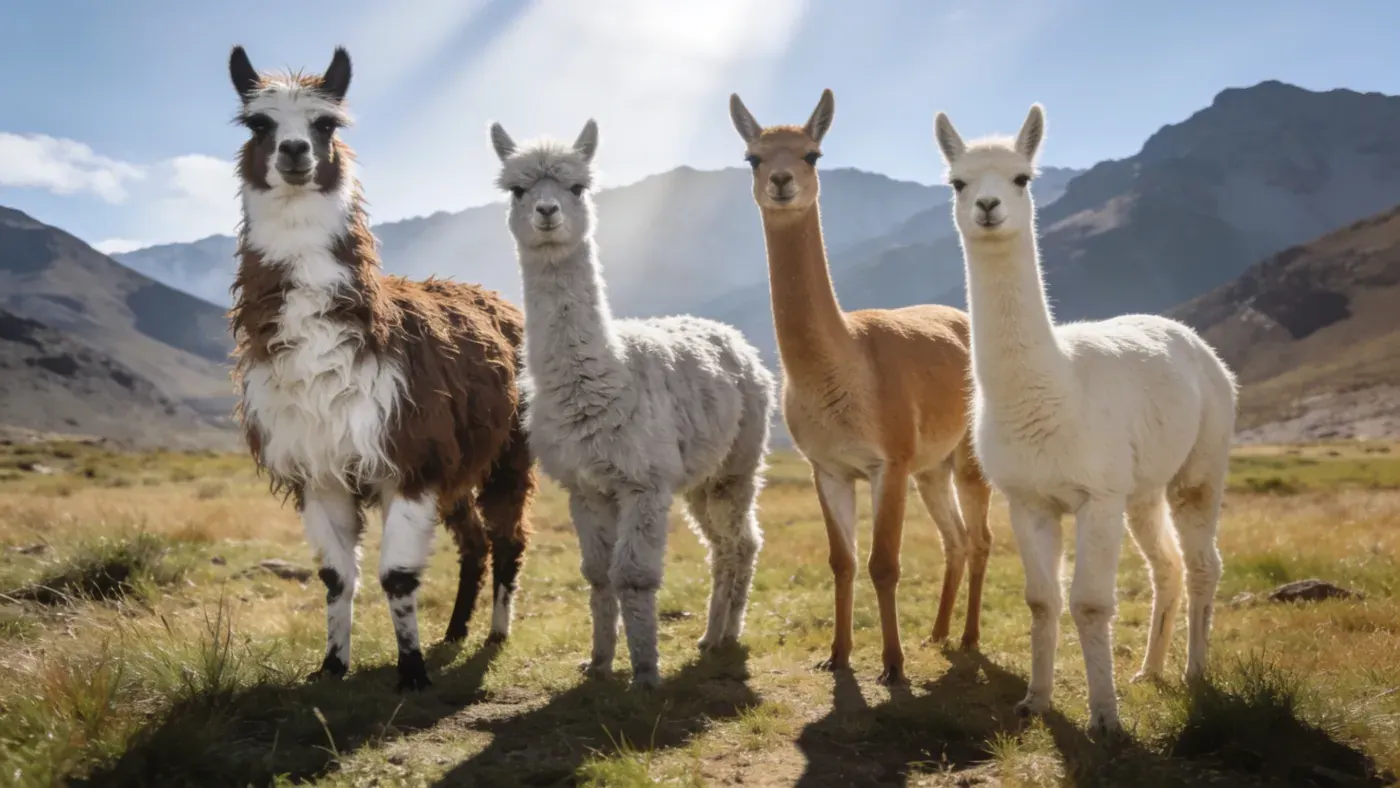
Four South American Camelids
The llama belongs to a small family of South American camelids that includes four species: the domesticated llama and alpaca, and their wild ancestors, the guanaco and vicuña, all native to the Andes Mountains.
The Guanaco: The Llama's Wild Ancestor
The guanaco is believed to be the wild ancestor of the domestic llama, still found roaming wild across parts of Peru, Bolivia, Chile, and Argentina in herds that move across open grassland and semi-arid terrain at high altitude.
The Vicuña's Prized Fiber
The vicuña, the wild ancestor of the alpaca, produces one of the finest and most valuable natural fibers in the world. Once hunted to near extinction for this fiber, vicuña populations have recovered significantly under protected status and regulated shearing programs.
Domesticated for Different Purposes
Llamas were domesticated primarily as pack animals capable of carrying heavy loads across mountainous terrain, while alpacas were bred mainly for their soft, fine fleece — a distinction in purpose that shaped each species' size, build, and temperament over thousands of years of selective breeding.