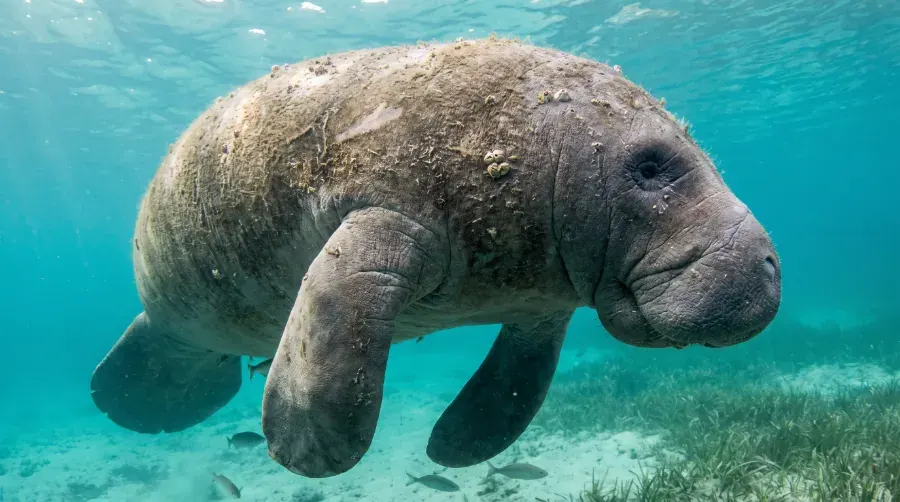
Unusually Dense Bones for a Marine Mammal
Unlike most marine mammals, manatees have unusually dense, heavy bones that help offset the buoyancy of their thick blubber layer, allowing them to remain neutrally buoyant and graze along the bottom without constantly fighting to stay submerged.
A Split Upper Lip for Grazing
A manatee's upper lip is split into two independently mobile halves, each covered in sensitive bristles, allowing it to grasp and manipulate seagrass and other vegetation with remarkable dexterity while grazing.
Constantly Regrowing Teeth
Manatee teeth wear down quickly from a diet of gritty, sand-covered seagrass, so new molars continually emerge at the back of the jaw throughout the animal's life to replace worn teeth further forward — a trait shared with elephants, their distant evolutionary relatives.
Excellent Underwater Hearing Despite No External Ears
Manatees lack visible external ears, but their hearing underwater is highly developed, with sound transmitted efficiently through the water and skull bones directly to the inner ear, allowing them to detect other manatees and potential threats even in murky conditions.