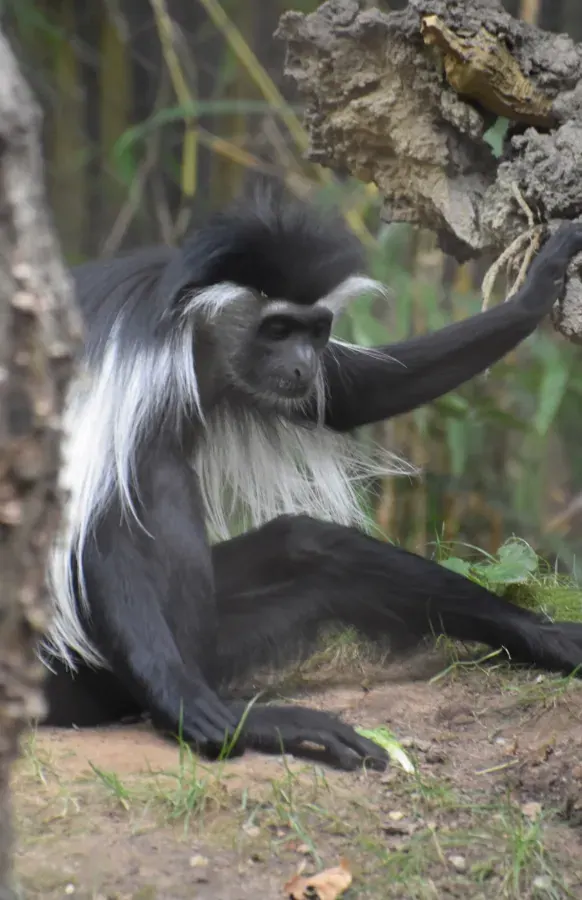
Small, Territorial Family Groups
Black-and-white colobus monkeys are social animals that live in relatively small groups, typically made up of around nine individuals — usually a single adult male, several females, and their offspring. These groups actively defend territory from neighboring troops.
A Cooperative Approach to Raising Young
Despite their territorial nature, colobus groups have been observed practicing allomothering, in which females from a different group help care for an infant that isn’t their own — a form of cooperative caregiving that isn’t universal among primates.
A Slow Reproductive Cycle
Female colobus monkeys reproduce roughly once every twenty months. After a gestation period of about six months, a female gives birth to a single infant at a time, investing significant time and care in each offspring before having another.
A Leaf-Heavy, Specialized Diet
The black-and-white colobus is primarily herbivorous, relying on a complex, multi-chambered digestive system to extract nutrition from a diet made up mostly of leaves. It supplements this with fruit and, on occasion, flowers, twigs, insects, seeds, and shoots.
An Accidental Role in Seed Dispersal
Colobus monkeys tend to be messy eaters, frequently dropping food as they forage. While inefficient for the monkey, this habit scatters seeds throughout the forest, making the species an important — if unintentional — contributor to forest regeneration.