Large, Loosely Connected Communities
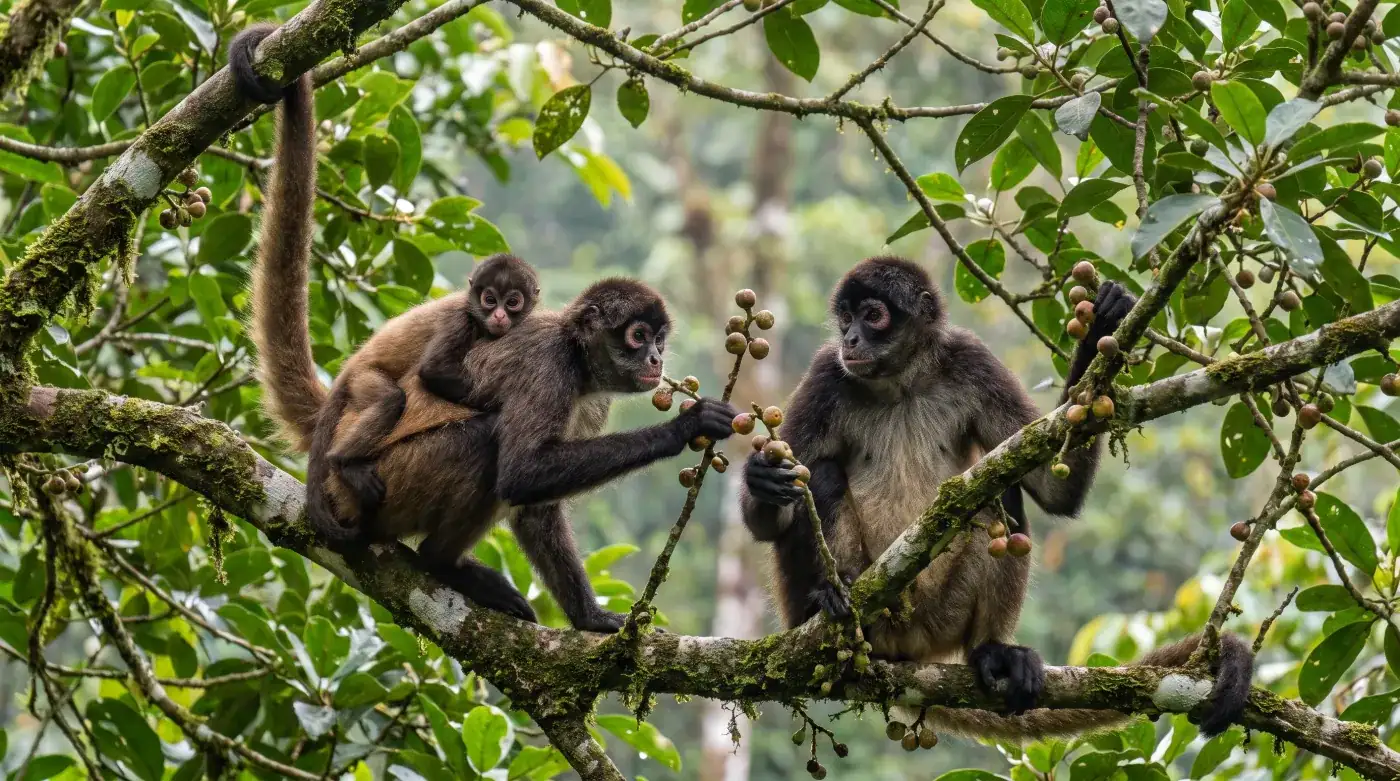
Spider monkeys are highly social, living in groups that typically number 15 to 25 members, occasionally growing as large as 40. Rather than moving as one unit, these larger groups are loosely connected and regularly split into smaller subgroups — usually two to eight individuals, though sometimes as many as 17 — to carry out daily activities.
A Female-Led Approach to Finding Food
Spider monkeys have an unusual foraging system in which a lead female searches out food sources for the group. If she can’t locate enough food to support everyone, the group splits into smaller subgroups that forage independently within their own territories, mostly during the morning hours between dawn and about 10 a.m.
A Highly Specialized, Fruit-Focused Diet
Fruit and nuts make up the bulk of a spider monkey’s diet, and the species is specialized enough to survive for extended periods on just one or two varieties. When preferred food is scarce, spider monkeys supplement their diet with honey, leaves, and bark, as well as occasional animal protein like insects and bird eggs.
Slow, Female-Driven Reproduction
Female spider monkeys reproduce only once every three to four years and choose their own mate when ready to breed. After a gestation period of roughly seven to eight months, a female typically gives birth to a single infant. Males take no part in raising young — infants depend entirely on their mothers for the first six to ten months of life.