Home / Amphibians / Newts
Amphibians · Caudata
Newt
Salamandridae
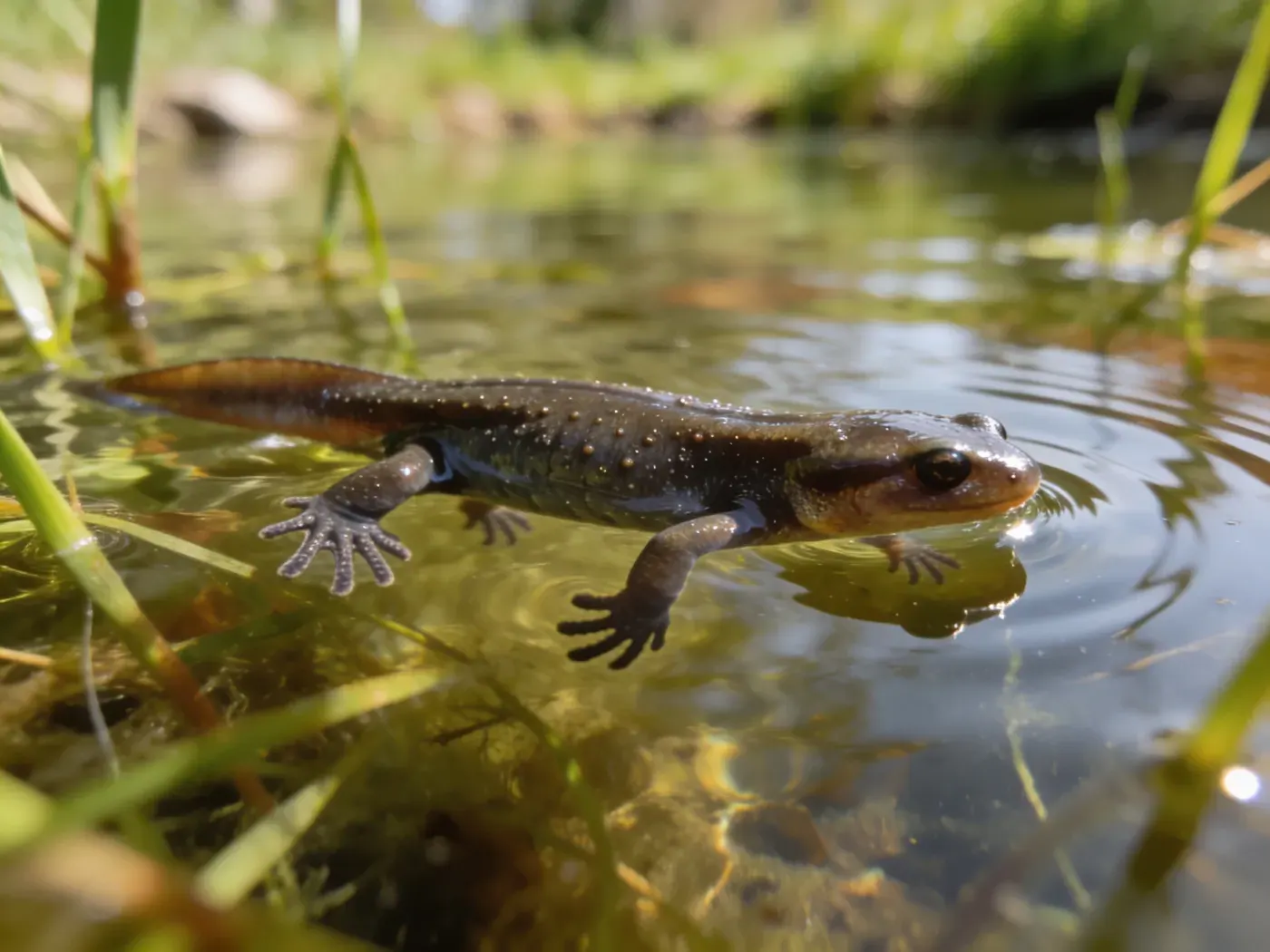
Newts are a group of salamanders that spend more of their adult lives in water than most of their relatives, often alternating between aquatic and terrestrial phases each year. Found across the Northern Hemisphere, several species carry potent skin toxins.
Classification
Kingdom: Animalia
Phylum: Chordata
Class: Amphibia
Order: Caudata
Family: Salamandridae
Species: About 100 described species
Related species: A subgroup within the broader salamander order
Weight
Typically under 2 oz
Habitat
Ponds, slow streams, and damp woodlands, Northern Hemisphere
Description
Aquatic phases often feature a flattened, paddle-like tail
Diet
Carnivorous — insects, small crustaceans, and worms
Lifecycle
Alternates between aquatic and terrestrial phases each year
Skin Toxins
Many secrete potent toxins, some dangerous to predators
Regeneration
Can regenerate limbs, tail, and even eye tissue
Breathing
Adults breathe with lungs but also absorb oxygen through skin
Did You Know?
Some newts, like the rough-skinned newt, produce a toxin potent enough to be lethal if ingested, despite their small size.
Did You Know?
Many newt species grow a flattened, fin-like tail each breeding season to swim more efficiently, then lose it when they return to land.
Did You Know?
Newts share the salamander order’s remarkable ability to regenerate lost body parts, including damaged eye lenses.
Types of Newts
Eastern Newt
Notophthalmus viridescens
Rough-Skinned Newt
Taricha granulosa
Great Crested Newt
Triturus cristatus
Alpine Newt
Ichthyosaura alpestris
Iberian Ribbed Newt
Pleurodeles waltl
Newt in Foreign Languages
Frenchtriton
Spanishtritón
GermanMolch
Italiantritone
Portuguesetritão
Dutchwatersalamander
Swedishvattenödla
Polishtraszka
Japaneseimori
Mandarinróngyuán
Koreanyeong-won
Russiantriton