A Bamboo-Heavy Diet
Bamboo leaves and shoots make up the vast majority of a red panda's diet, though it will also eat fruit, acorns, roots, eggs, and the occasional insect or small rodent when the opportunity arises. Unlike true herbivores, red pandas retain a carnivore's short, simple digestive tract, which extracts far fewer nutrients from tough plant fiber. To compensate, they must eat large volumes of bamboo — often over a pound and a half a day — and spend up to 13 hours a day foraging and feeding just to meet their energy needs.
The "False Thumb"
Gripping a smooth, round bamboo stalk is difficult with an ordinary paw, so red pandas evolved an extended wrist bone — the radial sesamoid — that acts as a sixth digit, opposing the true fingers much like a human thumb. This "false thumb" lets a red panda pin bamboo stems against its palm while stripping off leaves with practiced precision.
A Trait Shared With the Giant Panda
Remarkably, the giant panda — a bear, and only a distant relative of the red panda — evolved a nearly identical false thumb of its own, entirely independently. Scientists consider this one of the clearest examples of convergent evolution in mammals: two unrelated species, faced with the same problem of handling bamboo, arrived at the same anatomical solution millions of years apart.
Feeding Habits
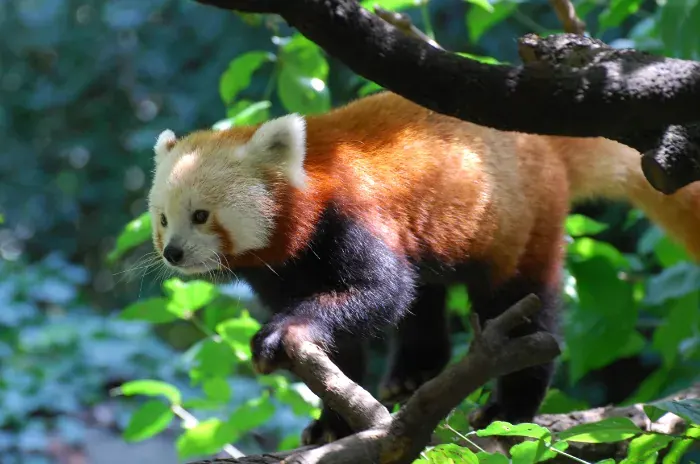
Red pandas are most active at dawn and dusk, resting through the heat of the day curled in a tree fork or hollow. They typically feed sitting upright, holding a bamboo stem in both front paws and bringing it to the mouth, stripping leaves much like a person eating corn on the cob.