Classification & Appearance
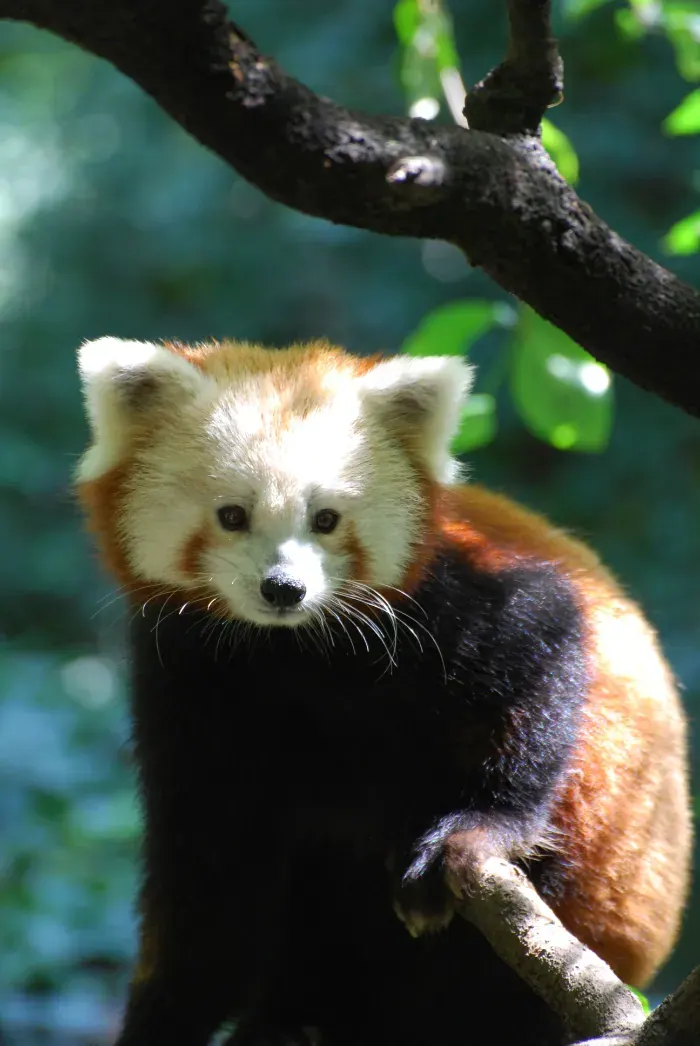
The red panda's scientific name is Ailurus fulgens, meaning roughly "fire-colored cat" — a nod to its rust-red coat. It is the only living species in the family Ailuridae, and despite sharing a name and a bamboo diet with the giant panda, genetic studies place it closer to raccoons, skunks, and weasels than to bears. Its round face is marked with white patches and dark tear-like streaks below the eyes, and thick fur on the soles of its feet insulates against cold, slippery branches and helps it grip icy surfaces.
Built for the Trees
Red pandas are among the most agile climbers in the mammal world. Semi-retractable claws, flexible ankles that can rotate nearly 180 degrees, and a long, bushy tail used as a counterbalance let them move confidently through the forest canopy, even head-first down a tree trunk. That same tail — banded with alternating rings of red and cream — also wraps around the body like a scarf, conserving body heat while the animal sleeps curled up on a branch through cold Himalayan nights.
A Second "Thumb"
Like the giant panda, the red panda has evolved an extended wrist bone that functions as a sixth digit, or "false thumb." It presses against the true fingers to grip smooth bamboo stalks securely — a rare example of two only distantly related species independently evolving the same clever solution to the same problem: eating a food that's hard to hold.
Solitary and Mostly Silent
Outside of the breeding season, red pandas live and forage alone, marking out and defending home ranges with scent from glands near the tail and anus. They are typically quiet animals, but when startled or communicating with a mate they produce quick, high-pitched twitters, squeals, or a huffing "quack" — sounds that carry surprisingly little resemblance to any noise made by a giant panda.
A Species Under Pressure
Red pandas are classified as Endangered, with wild populations estimated at under 10,000 individuals and believed to be declining. Habitat loss from logging and agriculture, fragmentation of the forest corridors pandas need to find mates, and poaching for their striking fur are the leading threats across their range in Nepal, Bhutan, India, Myanmar, and China.