A Narrow Mountain Range
Red pandas live in a thin, broken band of temperate forest running along the southern edge of the Himalayas and adjoining ranges, from Nepal and northern India through Bhutan and northern Myanmar into southwestern China. Within this range they stick to a fairly narrow elevation belt, roughly 6,600 to 13,000 feet, where cool, moist forest supports the dense bamboo understory they depend on.
Forest Structure Matters
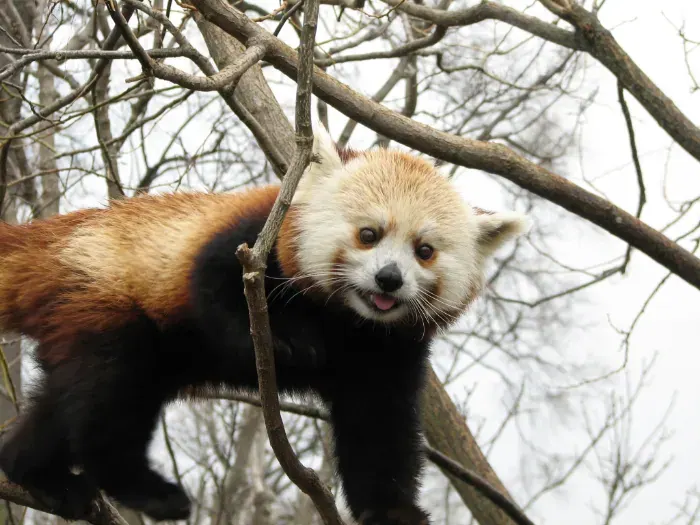
Suitable habitat needs more than just bamboo — red pandas require a mature forest canopy of conifers, oaks, or rhododendrons overhead, along with fallen logs and hollow trees for shelter and denning. This layered structure provides both an escape route into the trees from predators and the cover a largely solitary animal needs to avoid frequent contact with rivals.
Fragmented and Shrinking
Because red pandas need this specific combination of elevation, canopy, and bamboo, their habitat was never continuous — it exists as a patchwork of forest "islands" across steep mountain terrain. Logging, agricultural expansion, and new roads have cut many of these patches off from one another, isolating small populations and making it harder for red pandas to find mates or recolonize areas after local declines.
Two Recognized Populations
Researchers generally divide red pandas into a Himalayan population, found from Nepal through northern Myanmar, and a Chinese population east of that range, in Sichuan and Yunnan. Some taxonomists treat these as two distinct species — the Himalayan red panda (Ailurus fulgens) and the Chinese red panda (Ailurus styani) — based on differences in coat color, size, and genetics.