Not Actually Close Relatives
Despite sharing a name, a bamboo-based diet, and a corner of the same Asian mountains, red pandas and giant pandas belong to entirely different families. The giant panda (Ailuropoda melanoleuca) is a true bear, family Ursidae, while the red panda (Ailurus fulgens) is the only living member of its own family, Ailuridae — genetically closer to raccoons, skunks, and weasels than to any bear.
Size and Build
The size difference is dramatic: an adult giant panda can weigh 200 to 300 pounds and stand roughly waist-high on all fours, while a red panda tops out around 14 pounds — closer to a large house cat. Giant pandas are ground-dwelling and only occasionally climb, whereas red pandas are largely arboreal, spending much of their lives moving through the forest canopy.
Shared Solution, Different Ancestry
Both species independently evolved a "false thumb" — an enlarged wrist bone that functions like an extra digit for gripping bamboo. Because red pandas and giant pandas aren't closely related, scientists point to this shared adaptation as a textbook case of convergent evolution: unrelated species facing the same challenge and landing on a nearly identical anatomical fix.
Coloring and Coat
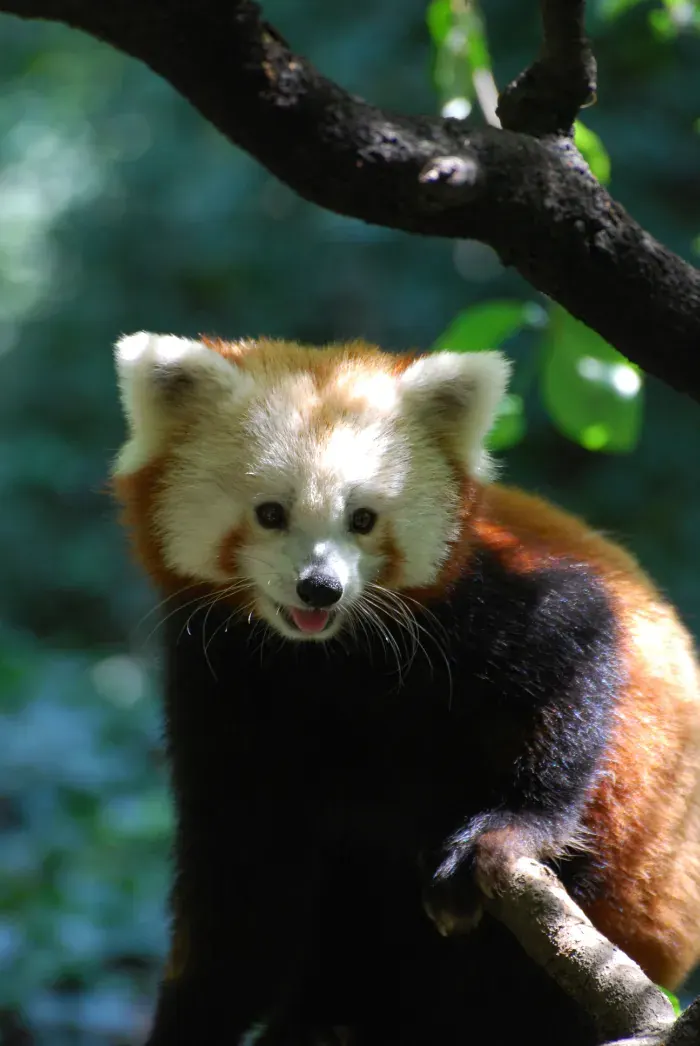
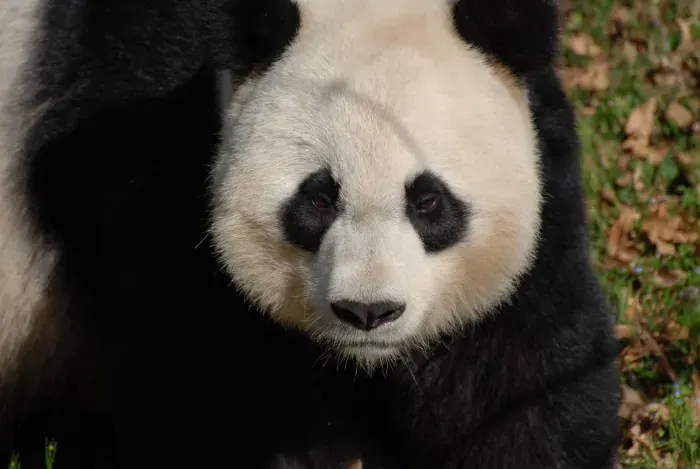
Giant pandas have the instantly recognizable black-and-white coat used worldwide as a conservation symbol, while red pandas are covered in a rust-red coat with a cream-and-black face and a long, ringed tail. Even their names diverge in some languages — the red panda is sometimes called the "lesser panda," a name most conservationists now avoid since it wrongly implies it is simply a smaller, less important version of the giant panda rather than a distinct species with its own evolutionary story.
Conservation Status
Giant panda numbers have slowly recovered thanks to decades of intensive, well-funded conservation work in China, and the species was downgraded from Endangered to Vulnerable in 2016. The red panda has received far less global attention and funding by comparison, and remains classified as Endangered, with its population still believed to be declining. Read more on our Giant Panda page.