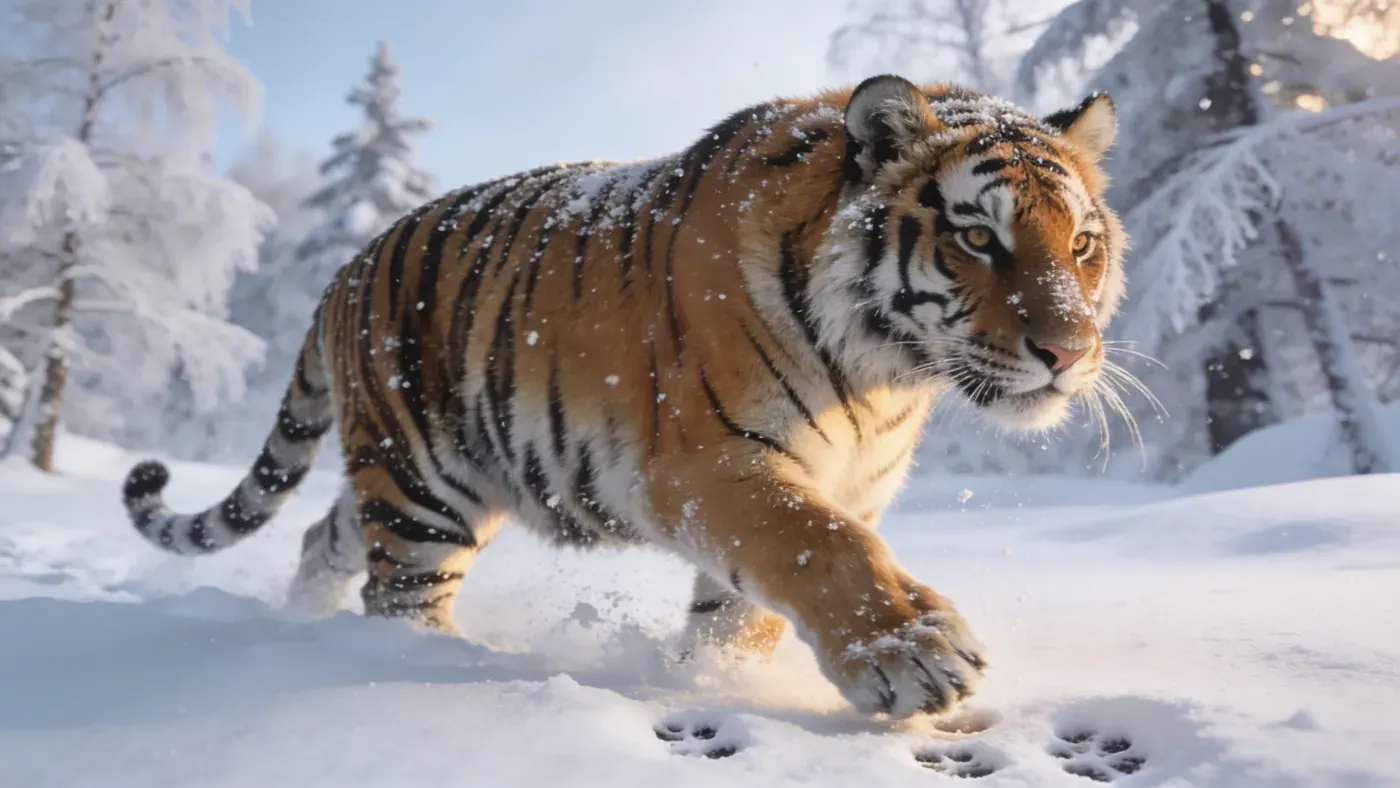
Where They Live
The Siberian tiger — also called the Amur, Manchurian or Korean tiger — survives today in a relatively small area of the far eastern Russian taiga, concentrated in and around the Sikhote-Alin mountain range. A small, closely watched population, numbering only around 20 individuals, persists just across the border in the forests of northeastern China.
Size and Appearance
This is the largest of all tiger subspecies. A typical adult stands roughly 44 to 47 inches at the shoulder and averages about 500 pounds, though the heaviest wild Siberian tiger on record weighed close to 850 pounds. Its coat runs rusty red to pale yellow with the same black striping shared by all tigers, set on a body that is noticeably longer-legged and thicker-coated than tropical subspecies, an adaptation to the Siberian winter.
Hunting and Diet
Siberian tigers hunt ungulates — red deer, roe deer, wild boar, and Manchurian elk are the mainstay of their diet, supplemented by smaller prey like hares and salmon when larger game is scarce. In years when ungulate numbers drop, a tiger may resort to preying on hibernating brown or black bears, though this remains an uncommon last resort rather than a regular strategy.
Genetics and Conservation Status
Genetic research has shown that the Siberian tiger and the now-extinct Caspian tiger were, in fact, the same subspecies, separated only by the vast distance between their ranges. That same research revealed unusually low genetic diversity in the wild population, evidence of a sharp population bottleneck driven by twentieth-century hunting. A 2005 survey counted fewer than 400 individuals living wild, and poaching pressure in the years since has kept the subspecies endangered despite ongoing anti-poaching and repopulation efforts.
Cultural Significance
Few animals carry the symbolic weight in the region that the Siberian tiger does. The historic Tungusic peoples regarded it as something close to a deity, and the Manchu people considered it a king among animals — reflected in the imperial Qing-dynasty naming of an elite military unit after it. That same reverence has a darker side: nearly every part of the tiger has long been sought after in traditional Chinese medicine, a demand that continues to drive poaching today.