A Shrinking Range
Tigers are native to Asia, where their historic range once stretched from Turkey in the west to the east coast of Russia. That range has collapsed to roughly 7% of its original extent, confined today to pockets of grassland, mangrove forest, evergreen forest, and Siberian taiga. The IUCN classifies the species as endangered.
Size and Appearance
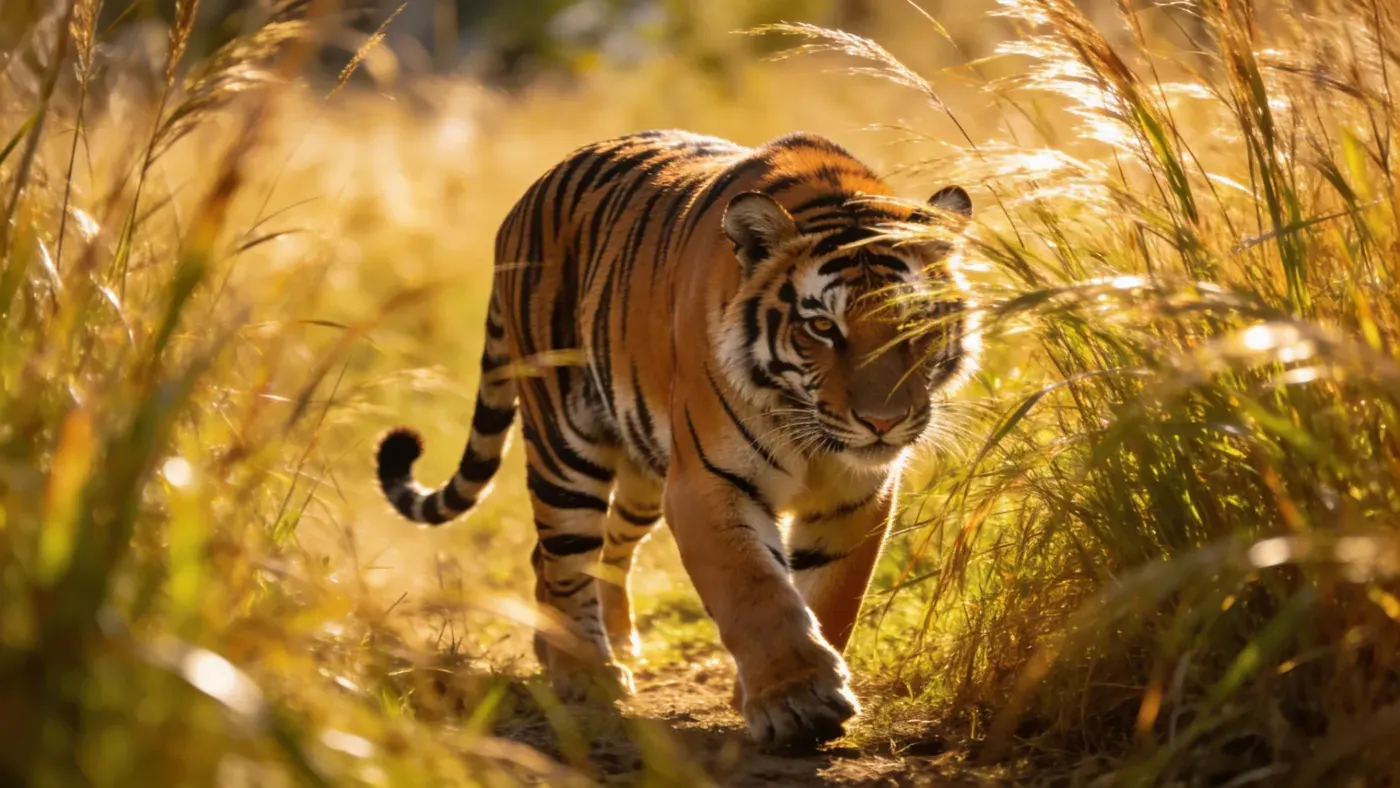
Tigers are the largest cat species and the third-largest land predator, reaching up to 11 feet in length and 670 pounds. Their signature red-orange coat, white underside, and black vertical stripes are unmistakable, though rare genetic mutations can produce an all-white tiger with black stripes or a pale gold, mostly white-legged variant sometimes called the golden tabby tiger.
An Apex Predator
Sitting at the top of their food chain, tigers favor deer and wild pigs but will also take birds, fish, reptiles, and small mammals — and on occasion other large predators such as leopards or bears. Powerful jaws, mostly small stout teeth, and canines up to four inches long make them well suited to killing prey far larger than themselves.
How Tigers Hunt
Tigers hunt primarily alone, relying on sight and sound rather than smell. They stalk to close range before attacking from the side or rear, killing with a bite to the neck or the back of the skull. A single tiger can eat close to 90 pounds of meat in one sitting.
Reproduction and Survival
Tigers can mate year-round but most commonly between November and April, with a gestation of roughly three and a half months. A typical litter holds three to four cubs, each weighing only about two pounds at birth, blind and entirely dependent on their mother. Cub mortality is steep — only about half survive to age two, the point at which they typically separate from their mother.
An Ongoing Struggle
Tiger range overlaps heavily with dense human populations, and tigers need large, continuous territory to survive — a combination that drives habitat loss, fragmentation, and poaching even as public concern for the species has grown. Rewilding efforts such as the Save China's Tigers project represent one avenue for slowing the decline.