A Genetic Rarity
White tigers are not a separate subspecies — they are ordinary tigers, almost always Bengals, carrying a rare recessive gene that suppresses the orange pigment in their coat. Only about 1 in 10,000 wild tiger births produces a white coat, which is why virtually every white tiger alive today, in the wild or in captivity, traces back to a small handful of related ancestors.
Appearance
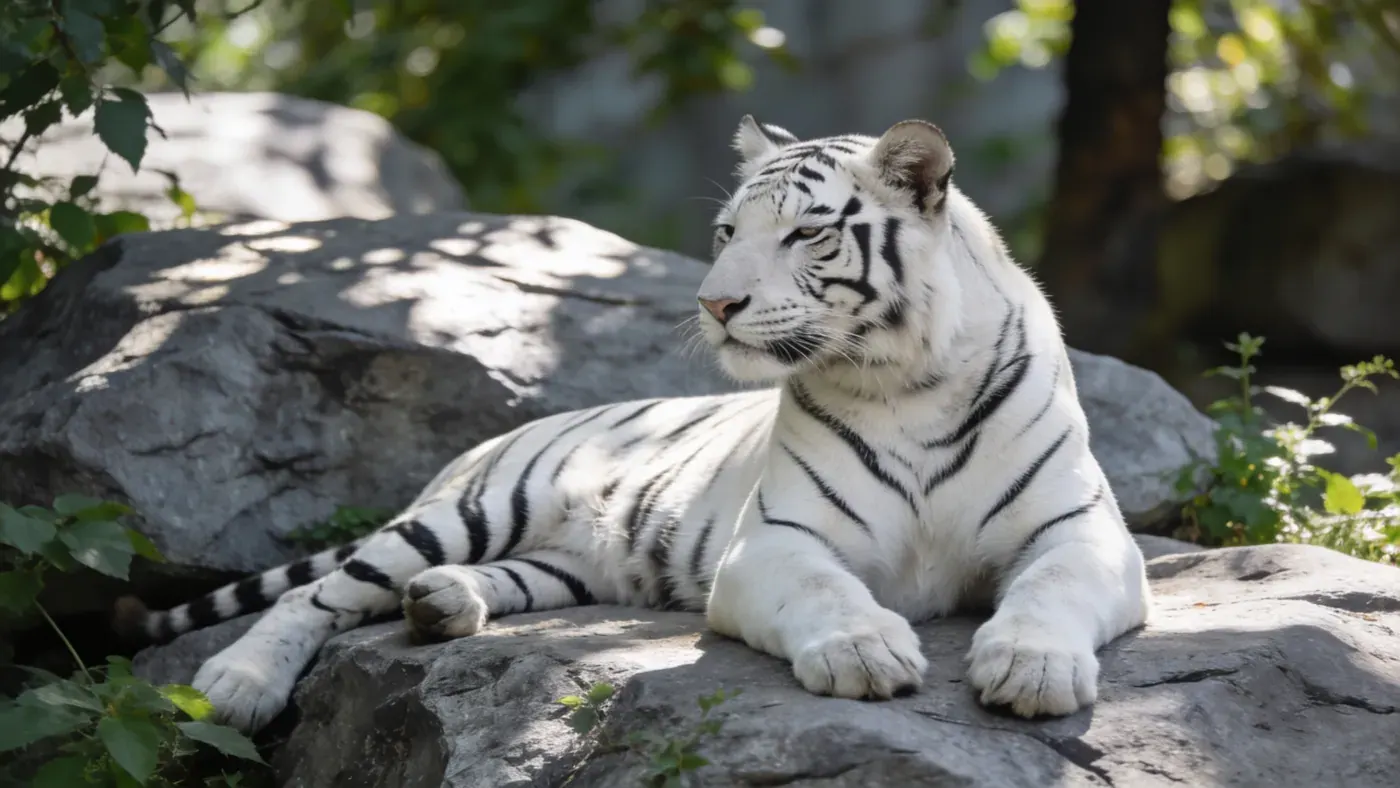
A white tiger has a pale, near-white coat marked with dark chocolate-brown stripes, and — distinct from albinism — retains pigment in its striking blue eyes. The coat pattern beneath the color shift is otherwise identical to that of a standard orange tiger, since the mutation affects pigment rather than the tiger's stripe pattern itself.
Habitat and Diet
Where they occur naturally, white tigers live in the same range of dense forest and, in colder climates, snow-covered terrain as other Bengal tigers, and hunt the same prey: deer, wild pigs, and fish. Diet and hunting behavior are unaffected by the coat color mutation.
Size and Life Cycle
White tigers give birth to litters of one to six cubs, and cubs remain with their mother for roughly two to two and a half years. Adults typically weigh between 400 and 550 pounds and measure 9 to 11 feet in length — broadly in line with standard Bengal tigers.
The Cost of Rarity
Because the white coat depends on a recessive gene carried by only a small ancestral population, breeding programs that perpetuate it rely heavily on inbreeding among closely related tigers. This comes at a real cost: white tigers tend to have shorter lifespans and a higher rate of health problems than their orange counterparts, which is why reputable conservation organizations do not support breeding for the white coat.