What is the Difference Between a Wolf and a Coyote?
Coyotes and wolves are different species entirely — a coyote is Canis latrans, while a wolf is Canis lupus. They're often confused at a distance, but size, speed, and pack behavior set them apart.
Pack Behavior
Coyotes typically hunt in pairs, though they're occasionally seen in larger packs — those packs tend to be smaller than a wolf pack, and the hierarchy within them is less stable. In areas where wolves have been eliminated, coyotes often move into the vacated territory; they also tend to coexist alongside humans far more easily than wolves do.
Vocalizations
Coyotes make a wider range of sounds than wolves — barks, howls, huffs, whimpers, whines, yelps and yips — most often heard at dusk or after dark, and especially during the spring mating season and in fall when young coyotes disperse to claim their own territory. When a coyote calls its pack together, it starts with a single rising howl; once the pack gathers, the howl rises in pitch and the rest join in with yips and yelps.
Range & Habitat
Wolves are found across Canada and portions of the United States, mainly in forests and tundra where large prey and open territory are still available. Coyotes are far more widespread and adaptable: their range stretches from Panama north through Mexico, the United States and Canada, and they thrive in deserts, plains, forests, and suburban and urban edges alike — habitats a wolf pack generally avoids.
Diet
Wolves are dedicated pack hunters, built to bring down large prey like deer, moose, elk, caribou and bison. Coyotes are opportunistic omnivores — rodents, rabbits and other small mammals make up most of their diet, supplemented with birds, insects, fruit and, near towns and cities, human food waste. That flexible diet is part of why coyotes have expanded their range even as wolf populations have contracted.
How to Tell Them Apart
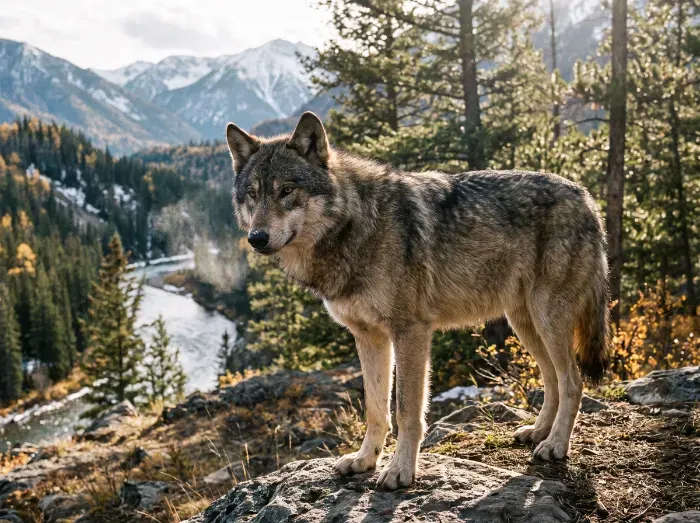
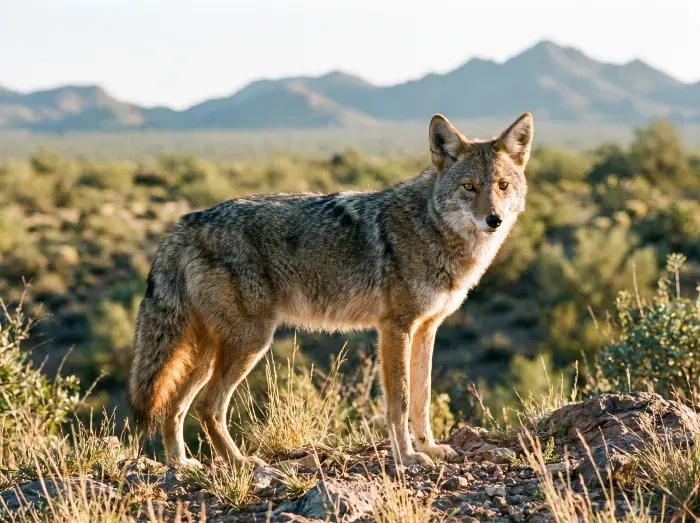
Size is the fastest tell at a distance — a wolf is noticeably bulkier, with longer legs and bigger paws built for its larger frame. Look closer and a coyote has a narrower, more pointed snout and proportionally larger, more pointed ears, while a wolf's muzzle and ears are broader and more rounded. Tail carriage is another clue: a running wolf tends to hold its tail out level with its back, while a fleeing coyote usually drops its tail low, almost between its legs.
Coyote-Wolf Hybrids
The line between the two species isn't always clean. In the northeastern United States and eastern Canada, many coyote populations carry measurable wolf (and even domestic dog) ancestry from historical interbreeding, a lineage often nicknamed the "coywolf." These eastern coyotes tend to run larger than their western counterparts, another sign of how closely related — and how easily confused — these two canids really are.