Mammals · Vermilingua
Anteaters
Myrmecophaga tridactyla (giant anteater)
Vulnerable
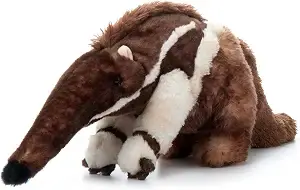
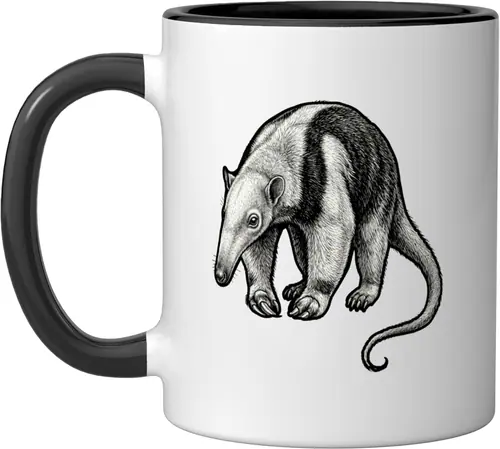
Anteaters are toothless mammals native to Central and South America, using long snouts and sticky tongues to feed almost entirely on ants and termites.

Classification
Kingdom: Animalia
Phylum: Chordata
Class: Mammalia
Order: Pilosa
Suborder: Vermilingua
Other names: Antbear, ant bear
Anteater Species
Pygmy Anteater (Silky Anteater)
Cyclopes didactylus
Giant Anteater
Myrmecophaga tridactyla
Lesser Anteaters (Tamandua)
Tamandua tetradactyla / Tamandua mexicana
Size
The silky anteater is the smallest species at 14–18 in. long and about 14 oz. The giant anteater is the largest at 40–48 in. long (plus a 28–35 in. tail) and 60–140 lbs. Males are heavier than females.
Habitat
South and Central America — dry tropical forest, rain forest, grassland and savanna.
Description
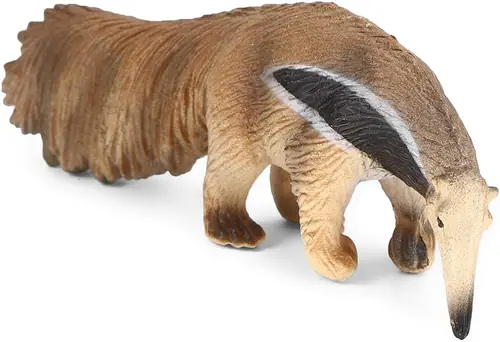
A long, sticky tongue and powerful claws; a tube-shaped mouth with lips but no teeth; dense, long fur that protects against insect bites; small rounded ears and small eyes. All species except the giant anteater have a prehensile tail.
Diet
Large, curved front claws tear open ant and termite mounds; anteaters also eat beetle larvae and bees.
Senses
Good hearing, poor eyesight, and an excellent sense of smell.
Behavior
Anteaters defend a home territory of about 1 to 1.5 square miles.
Gestation
Giant anteaters carry their young for about 190 days; gestation length varies by species.
Life Span
Varies by species. Pumas and jaguars are natural predators of the anteater.
Social Structure
Adult anteaters are normally solitary.
Did You Know?
Anteaters have the lowest body temperature of any mammal, and can tolerate greater fluctuations in body temperature than most mammals.
Did You Know?
The Spiny Anteater, Banded Anteater, Cape Anteater and Scaly Anteater are not considered "true anteaters" — they belong to entirely different mammal families.
Did You Know?
An anteater’s tongue can be up to 2 feet long — but it has no teeth at all in its mouth.
Did You Know?
Giant anteaters walk on their knuckles to protect the long, curved digging claws used to tear open ant mounds.
Anteaters in Foreign Languages
Armenianmrjnaker
Cherokeedosvdali digayesgi
Mandarinshíyǐshòu
Croatianmravojed
Czechmravenečník
Danishmyresluger
Dutchmiereneter
Estoniansipelgakarugija
Finnishmuurahaiskarhu
Frenchfourmilier
GermanAmeisenbär
Greekmyrmigkofágos
Hungarianhangyász
Icelandicmauraæta
Italianformichiere
Japanesearikui
Navajowóláchííʼ yildeełí
Norwegianmaursluker
Polishmrówkojad
Portuguesetamanduá
Romanianfurnicar
Russianmuravjed
Spanishoso hormiguero
Swahilikiharara / loma
Turkishkarıncayiyen
Ukrainianmuraxojíd