Mammals · Ursids
Giant Panda
Ailuropoda melanoleuca
Vulnerable
The giant panda is a bear native to the mountain bamboo forests of central China, instantly recognized by its bold black-and-white coat. Despite belonging to the order Carnivora, its diet is almost entirely bamboo — a specialization so extreme it has reshaped the animal’s anatomy, behavior and daily routine around a single, low-nutrition plant.
Classification
Kingdom: Animalia
Phylum: Chordata
Class: Mammalia
Order: Carnivora
Family: Ursidae
Genus: Ailuropoda
Species: melanoleuca
Note: A true bear, not related to the unrelated red panda despite the shared name
Size
4–6 ft long; 2–3 ft at the shoulder on all fours.
Weight
150–300 lbs; males are somewhat larger than females.
Habitat
Temperate mountain bamboo forest in a handful of ranges across central China, primarily Sichuan, at 5,000–10,000 ft elevation.
Description
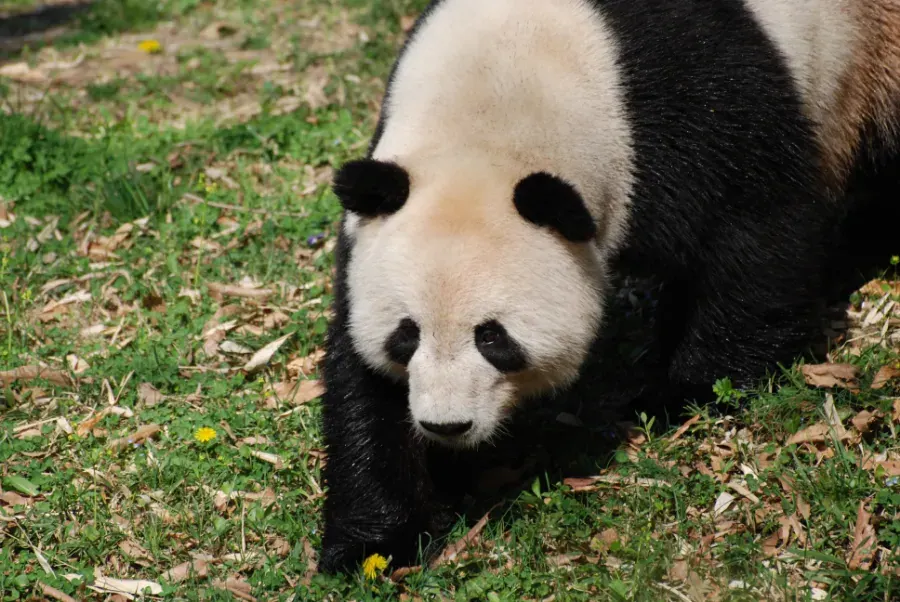
A stocky bear with distinctive black-and-white markings — black patches around the eyes, ears, legs and shoulders on an otherwise white body.
Diet
99% bamboo — stems, leaves and shoots — consuming 20–40 lbs a day, up to 12 hours spent eating.
Digestion
Retains a carnivore’s short, simple gut and extracts only around 20% of the nutrition from the bamboo it eats, forcing near-constant feeding.
The "sixth finger"
A modified wrist bone functions as an opposable thumb, letting a panda grip bamboo stalks the way no other bear can.
Communication
Bleats, honks and chirps rather than a bear’s typical growl; scent marking is the primary way pandas, who are largely solitary, communicate territory and readiness to mate.
Gestation
About 95–160 days, varying widely due to delayed implantation.
Birth & Litter Size
Usually a single surviving cub (twins occur but the mother generally raises only one), weighing about 3–5 oz at birth — roughly 1/900th of the mother’s weight, among the smallest newborn-to-mother ratios of any placental mammal.
Sexually Mature
4–8 years.
Life Span
15–20 years in the wild, up to 30 in captivity.
Did You Know?
A newborn giant panda weighs about as much as a stick of butter — roughly 1/900th of its mother’s weight, one of the largest size gaps between a newborn and its mother of any placental mammal.
Did You Know?
Despite being classified in the order Carnivora, a giant panda's diet is around 99% bamboo, and it retains the short digestive tract of a meat-eater, extracting only a fraction of the nutrition other herbivores get from plants.
Did You Know?
A panda's wrist bone is enlarged into a false "sixth finger" that works like a thumb, letting it grip bamboo stalks — a feature no other bear species has.
Panda in Foreign Languages
Frenchpanda géant
GermanGroßer Panda
Italianpanda gigante
Portuguesepanda-gigante
Spanishpanda gigante
Russianbol’šáya pánda
Polishpanda wielka
Mandarindàxióngmāo
Cantonesedaaih hùng māau
Japanesejaiantopanda
Koreandaepanda
Hindipanda
Arabical-baanda al-’imlaaq
Greekgígantas pánda
Turkishdev panda
Dutchreuzenpanda
Swedishjättepanda
Vietnamesegấu trúc lớn
Thaiphaenda yak
Indonesianpanda raksasa