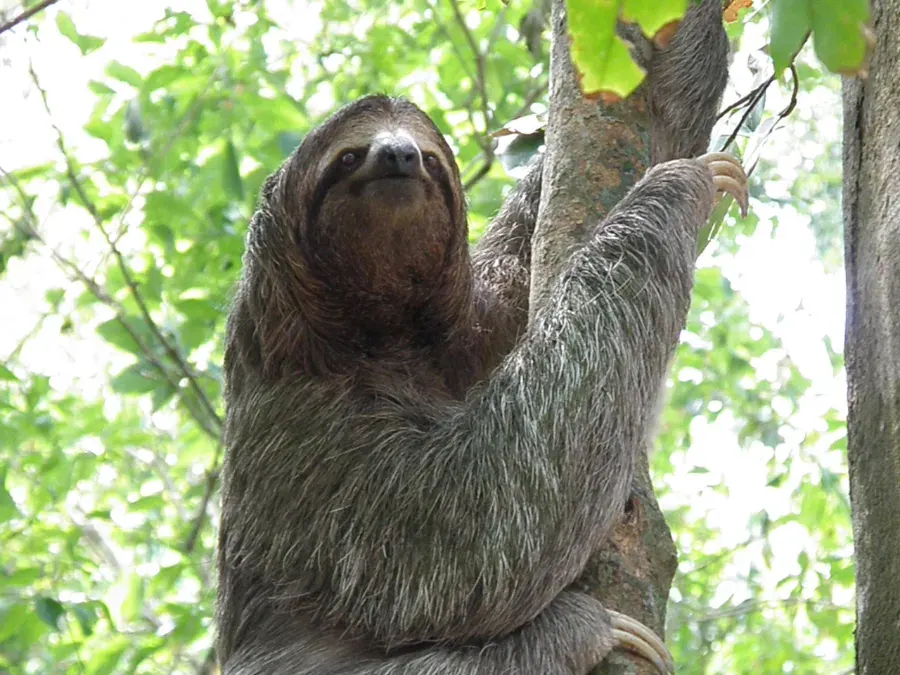
Sloths are slow-moving tree dwellers of Central and South America. Six species are recognized in two families: two species of two-toed sloth and four species of three-toed sloth. Despite the names, all have three toes on the hind feet; the difference is the number of fingers on the front.
Slow by design
Sloths eat leaves, a low-energy food, and their metabolism runs at roughly half the rate expected for a mammal of their size. They move at a fraction of a mile per hour on the ground and spend most of their lives hanging upside down from branches. Strong claws let them hold on even while asleep, and they swim surprisingly well.
Algae and moths
The coarse outer hairs of a sloth’s coat host green algae that tint the fur and help it blend into the canopy, and a community of moths and beetles lives within it. Sloths descend about once a week to defecate at the base of a tree, a risky trip that also feeds the moths that live in their fur.
Young and lifespan
A female gives birth to a single baby after a gestation of about six months in three-toed species and nearly a year in two-toed species. The infant clings to its mother for months. Sloths can live 20 to 30 years or more, and the pygmy three-toed sloth, found only on one small Panamanian island, is critically endangered.