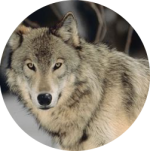
Arctic Wolves
The sun hangs leaden in the sky over the frozen tundra of
the high arctic. Flat expanses of land are dotted with low-growing
shrubs dusted with frost. From the south a herd of musk oxen
loiter along, digging away the icy surface of the ground to
reach nutritious lichen and ground plants, oblivious as eight
stealthy white figures move in around them. As the wolves
get closer, the herd snaps into action, forming into two rings,
with younger calves in the middle protected by the adults
facing outward. The circle would be impossible for one wolf
to penetrate, so the pack must work as a team. Back and forth
race the wolves, snapping at the legs of creatures five times
their weight. Standing shoulder to shoulder, the musk oxen
hold their ground, using their massive horns and hard skulls
to throw off the charging wolves. The wolves tear from one
side to the other, shifting the disoriented herd, until one
infiltrates the circle. The herd scatters as wolves give chase.
The race does not last long, for musk oxen overheat and tire
easily, unlike wolves which are able to maintain high speeds
over much longer pursuits. A weakened musk ox falls back from
the herd, and the wolves focus in on it. The largest of the
pack, the alpha male, leaps and grasps its victim’s neck in
a desperate hold. The mighty animal collapses in a heap.
Statistically, only one in ten wolf attacks are successful,
and it has been several days since the pack has obtained such
a large kill. They will each eat up to 20 pounds of meat at
this meal, leaving nothing of the animal behind, neither bones
nor fur. A few miles away the alpha female cares for her month-old
cubs, waiting for the herd to bring back food. The pack shares
in the responsibility, even regurgitating meat for the cubs
to eat.
Arctic wolves, also known as polars and whites, have thrived
in the high arctic for thousands of years, one of the few
mammals able to tolerate the sub-zero temperatures and five
months of darkness. Indeed, they have been more successful
than their gray cousins to the south, who have barely escaped
extinction due to their encounters with man. There are few
differences between the arctic and gray wolf subspecies. The
white wolf is slightly shorter, standing 25-31 inches high
at the shoulder. But they are bulkier; an adult male can weigh
up to 175 pounds. Smaller, rounded ears and thicker fur are
physical adaptations that have allowed the arctic wolf to
weather its inhospitable terrain.
To survive, wolves live in small packs of 7-10. The family
group consists of a breeding pair (the alpha male and female),
their pups, and their unmated offspring from prior seasons.
A strong hierarchy exists within packs, and the dominant animals
will force inferiors to cringe or lie on their backs to show
respect. Lesser wolves hold their tails at a lesser angle
than the dominant male. Males reach maturity at 3 years old,
but they may strike out on their own anytime after their first
year. Lone wolves are at great peril, and they will avoid
contact with other wolves unless it’s a potential mate. Then
the male will find and claim an unoccupied territory, marking
it with its scent.
Wolf territories are vast (as large as 800-1,000 square miles),
as they must roam areas large enough to supply the amount
of food needed by a pack. Their primary food source is musk
oxen, caribou, and smaller mammals such as lemmings and hares,
but wolves will eat anything they can catch. They may follow
migrating caribou south in the summer. Arctic wolves are found
all along along the northern edge of the North American continent,
and along the eastern and northern shores of Greenland. They
are sometimes confused with another distant cousin, the tundra
wolf, of northern Europe.
Wolves may be the most misunderstood and maligned animal
in the world, due to their elusiveness and to superstitions
stretching back to prehistory. However, their pack structure,
hunting methods, and general curious and friendly natures
suggest that wolf and man may have more in common than was
ever imagined.
About the Author
Emma Snow has always adored wild animals. Emma provides content
for Wildlife Animals http://www.wildlife-animals.com
and Riding Stable http://www.riding-stable.com.

artic wolf
|
 Site
Map
Site
Map