The Kodiak Bear
Early May on Kodiak Island. Fog drowns the lush forest in
mystery. Spattered across a black earthen floor, slushy snow
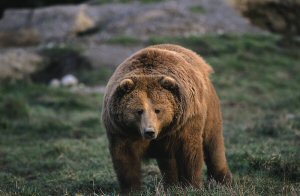
melts in shadowy rings. From a wooded den, a shaggy brown
head appears. Unbelievable in size, the creature emerges slowly.
Ursus arctos middendorffi, Alaska’s Kodiak Bear, awakes from
her long winter’s nap. She's not alone. Snuggled close to
her massive front paws sit two cubs, the size of stuffed Teddy
bears. Together they weigh only twenty pounds, and are hardly
noticeable in comparison to their 500 pound mother. Though
large, the sow is lean, for she has lost 30% of her body weight
over the winter. Giving birth, nursing, and caring for her
young has taken its toll, and now is the season for eating.
One at a time, she carries her cubs in her jaw out of the
den and sets them rolling on the forest floor.
Kodiak Island is sometimes called “Alaska’s Emerald Isle.”
With knobby mountains, countless waterfalls, finger lakes,
and deep narrow inlets, it could well be called Neverland,
for it is the place of fantasy. After Hawaii, it is the second
largest island in the United States, 3,800 square miles largely
devoted to the vast National Wildlife Refuge. With 117 salmon
streams, 14 major watersheds, and less than 100 miles of road,
it is the perfect place for the Kodiak Bear.
Kodiak Bears have existed on this island for 12,000 years.
With their stream-lined noses and larger bone structure—they
are the world’s largest bear—Kodiaks are the only scientifically
recognized sub-species of the Brown Bear. Separated as they
are from the continent, Kodiaks have a smaller gene pool.
But this is not the only difference. Other bears, grizzlies
and browns, require one or two hundred miles for survival,
taking their food requirement into account. Here on Kodiak
Island, where food is abundant, the population of bears is
denser than anywhere else on earth. There are 0.7 bears per
square mile, a total population of close to 3,000 bears on
Kodiak and the surrounding archipelagos. Due to their close
proximity, these bruins have developed a more diverse social
structure, with large boars and sows with cubs vying for dominance.
Single subadults, aged 3 to 5 years take up the bottom rungs
of the hierarchy.
For good reason bears capture the interest and hearts of
many. Bear watchers, who keep a proper distance, sometimes
term these creatures “gentle giants.” Adult boars stand up
to ten feet tall and weigh between 750 and 1,500 pounds. (Females
are considerably smaller at 350-750 pounds.) They live fascinating
lives, and are as unique and unpredictable as humans. Weighing
less than one pound, hairless, blind, and toothless, cubs
enter life almost as helpless as human babies. One to three
cubs is born in each litter, although sows have been spotted
with up to five cubs. Litter size largely depends on the health
of the mother and food availability. By the end of their first
year of life cubs weigh up to 80 pounds. For two to four years
cubs remain with their mothers, who teach them the skills
needed for survival before chasing them off.
No skill is more important to a Kodiak than eating, and this
activity takes up most of its waking hours. Although classified
as a carnivore, bears are actually omnivorous, and eat everything
from grasses and berries to fish and carrion. Eating patterns
maximize nutritional content. Emerging from their dens as
early as March, bears will eat grass and sedges in the spring
when they grow most abundantly. They feast on fish when the
salmon run begins in the summer. These months are crucial
as bears must gain three to six pounds of fat per day to survive
hibernation. This is the time to catch a glimpse of the bear
in the wild, as they will compete over the best fishing spots
along a stream. As the salmon supply dwindles, bears turn
their attention to berries, which are at their peak as autumn
approaches. If the food supply has not been adequate, a bear
may not hibernate.
At about five or six years old, female Kodiaks begin breeding.
Bears are serially monogamous, and boars will sometimes fight
over a mate, sometimes causing serious injuries. Mating season
peaks in June, although embryo implantation will not occur
until the impregnated sow is denned in November. Only if she
has gained the necessary weight for hibernation will the embryo
implant and the eight week gestation begin.
In response to the winter food shortage, bears hibernate
through the winter months. During this time they will not
eat, urinate, or defecate. Astonishingly, they lose very little
bone mass or muscle tone. But hibernating bears are not unconscious.
Although their body temperatures drop close to the surrounding
temperature, bears’ metabolic rates remain high. They curl
up to conserve heat, and may change their positions in their
dens. Aroused, bears may even attack, although this is very
rare. Only one person has been killed by a Kodiak Bear in
the last 75 years. Bear-caused injuries occur about one every
other year on the island.
Although they are the largest predator on the earth, bears
are normally shy and not aggressive toward humans unless provoked
or afraid. With their slot secure at the top of the food chain,
the Kodiak’s only natural enemy is man. Hunting on Kodiak
Island is only allowed under the tightest of regulations.
About 5,000 resident hunters apply per year for one of the
319 bear permits. Non-residents are required to hire a professional
guide, an expense between $10K-$15K per hunt. 160 Kodiak bears
are killed each season, with 70% of them males. Otherwise,
Kodiak Bears enjoy relatively long lives between 20 and 30
years.
It is not uncommon to hear a bear watcher speak of their
quarry as if they are family. These outdoorsmen may track
a sow and her cubs for years, and may even give them names.
Some consider bears our cousins, and certainly there is a
kinship. Perhaps it started when we squeezed our first Teddy
Bear.
About the Author
Emma Snow has always adored wild animals. Emma provides content
for Wildlife Animals http://www.wildlife-animals.com
and Riding Stable http://www.riding-stable.com.
|
 Site
Map
Site
Map